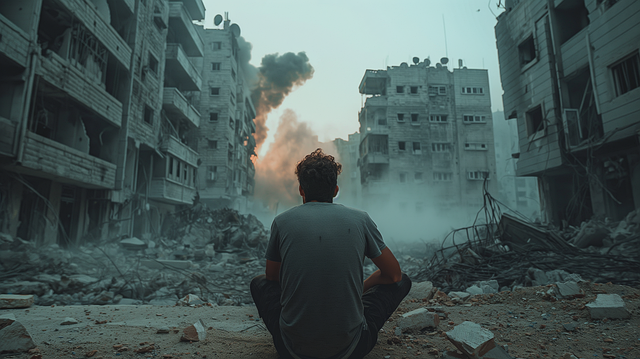
Donald Trump’s suggestion that Egypt and Jordan temporarily host Gazan civilians during Gaza’s reconstruction was immediately condemned as “forced eviction” and “transfer.” Yet the region’s political history, demographic realities, and the physical state of Gaza itself complicate the picture. This article examines why Egypt and Jordan reject the idea, why many Gazans might welcome the chance to leave, and why insisting they remain in a literal demolition site may be the least humane option of all.
The moment Trump suggested that Egypt and Jordan temporarily take in Gazan civilians, critics framed it as “transfer” — a term loaded with historical trauma and accusations of racism. For many, the idea evokes fears of ethnic cleansing or right‑wing fantasies of an “Arab‑rein” Gaza. But Trump’s comments were not about ideology. They were about the physical reality of Gaza after the war: “It’s literally a demolition site right now,” he said. That phrase is the key to understanding the humanitarian logic behind the proposal.
Why Egypt and Jordan Reject the Plan
Egypt immediately rejected the idea, calling it “forced eviction.” Their refusal is rooted in decades of policy. Egypt has long feared the influence of the Muslim Brotherhood, the ideological parent of Hamas. President El‑Sisi has no interest in absorbing Gazans who might strengthen Islamist networks inside Egypt. Even in 1978, during peace negotiations, President Sadat refused to take Gaza back, despite Israel offering it alongside the Sinai.
Jordan’s refusal is equally predictable. With a population that is already majority Palestinian Arab, Jordan’s leadership fears that accepting more Gazans would destabilize its fragile national identity. As one Egyptian scholar wrote in a thesis on Jordanian citizenship, the state maintains strict legal boundaries to prevent Palestinians from overwhelming Jordanian identity. Jordan’s foreign minister put it bluntly: “Jordan is for Jordanians, and Palestine is for Palestinians.”
Given this history, their rejection is unsurprising. But it does not answer the humanitarian question.
The Humanitarian Blind Spot
If Gaza is a demolition site — and it is — why insist that civilians remain inside it? In any urban renewal project, residents are relocated before demolition and reconstruction begin. No one expects families to pitch tents on the rubble of their former homes and wait for new apartments to be built. Even during minor renovations, people often move out temporarily to avoid dust and debris.
Yet when it comes to Gaza, the world demands that civilians stay put. Syrians and Ukrainians were welcomed across borders as war refugees. Gazans, by contrast, are told they must remain in the ruins because their suffering is politically useful. Their misery is framed as evidence of Israeli wrongdoing — and therefore must remain visible.
What Gazans Themselves Want
Long before October 7th, surveys by Palestinian NGOs showed that many Gazans wanted to emigrate for economic, educational, or political reasons. After losing homes, neighbourhoods, and livelihoods, how many would choose to leave temporarily if given the chance? Likely the vast majority. Yet the international community insists they stay — not for their benefit, but to preserve a political narrative.
You can read the full in‑depth Substack version of this article here.
👉 Subscribe to my Substack newsletter to follow my new essays and access all full‑length pieces, including extended interviews, analysis, and research: Israel Diaries – The Deep Dive
Full Series
- The Gulf States have moved on from Palestine
- Statehood? Not so fast The Gulf’s real attitude to Palestine
- Neighbours Egypt and Jordan privately oppose Palestinian statehood
- Diplomacy’s Denial: American and the peace process that is not
- Europe loudly says “Palestinian state.” Under its breath: “not really.”
Discussion (0)
No comments yet. Be the first to share your thoughts!
Leave a Comment