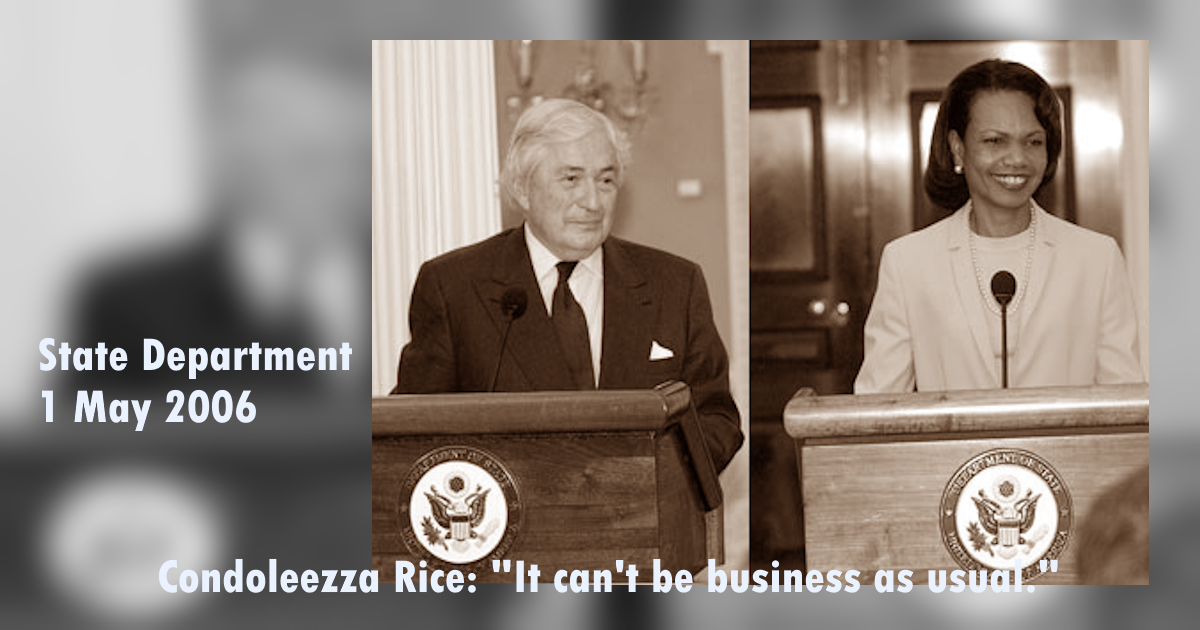
In 2005, Israel, the Palestinian Authority, and the United States launched a coordinated plan to rebuild Gaza after Israel’s disengagement. The effort included the Agreement on Movement and Access and a Quartet‑appointed envoy, James Wolfensohn. By May 2006, Wolfensohn resigned, concluding that the political conditions required for success no longer existed. As a new international coalition prepares to rebuild Gaza today, the failures of 2005-6 offer critical lessons.
The 2005 vision for Gaza imagined a thriving, connected society emerging after Israel’s disengagement. Israel withdrew its settlers and military forces, and although the decision was unilateral, the withdrawal itself was coordinated with the Palestinian Authority and the United States. James Wolfensohn, appointed by the Quartet, was tasked with helping both sides implement the transition. Condoleezza Rice described his work as essential to ensuring the withdrawal “took place successfully.”
In May 2006, Wolfensohn resigned. His explanation revealed why the political foundation for rebuilding Gaza had collapsed. The election of Hamas created what he called “a very difficult moment,” because Hamas emphasized the destruction of Israel and refused meaningful communication. Rice echoed this, saying the Quartet’s minimum conditions for engagement had not been met and that without those political conditions, the reconstruction plan could not move forward.
The withdrawal had been followed by the Agreement on Movement and Access, a U.S.‑brokered PA‑Israel framework envisioning a prosperous Gaza with improved crossings, expanded trade, and healthier social conditions. But Hamas’s victory made these arrangements untenable. Rice stated plainly that “the Israelis do not any longer occupy Gaza; it is Palestinian territory,” yet the political environment required for economic development had evaporated.
Wolfensohn warned against punishing ordinary Palestinians, calling starvation and school closures “a losing gambit.” Still, he insisted that Palestinians must accept that the future required resolving difficult issues — and that “you don’t start by telling the other side that you’re going to shoot them.”
Twenty years later, a new international Board of Peace is preparing to rebuild Gaza. The Israeli cabinet has approved its pilot project in Rafah. Wolfensohn’s remarks are no longer historical footnotes but warnings. Hamas is militarily weakened, and today’s coalition is broader, but the core question remains: can Gaza be rebuilt without first resolving who governs it and what relationship that authority has with Israel? Or will economic success in one part of Gaza be expected to create the political foundations that were missing in 2006?
You can read the full in‑depth Substack version of this article here.
👉 Subscribe to my Substack newsletter to follow new essays and access full‑length pieces, analysis, and research: Israel Diaries – The Deep Dive
Discussion (0)
No comments yet. Be the first to share your thoughts!
Leave a Comment