The story of Joshua breaking through the walls surrounding Jericho makes for a catchy song. However, there is a debate among archeologists regarding the authenticity of the events as told in the Bible. According to some, the destruction of the walls pre-date the Israelite entry into the region. In any case, on Saturday, January 18, 2014, I joined a group of Israelis and internationals, the former mostly seniors (like me) and the latter mostly university students, for a tour of Jericho. The trip was organized by IPCRI, an organization working toward the promotion of cooperation among Israelis and Palestinians. The stated purpose of the trip was to break down the psychological walls that separate our two peoples - the Israelis and the Palestinians. Would this be a fiercely political trip geared toward showing the horrors of Israeli occupation? I was a bit concerned that it might be just that, but determined to keep my mouth shut and listen and learn.
The Road to Jericho
I didn't pay attention to the time, but it seems that once you leave Jerusalem, are in Jericho in almost no time at all. Very quickly the desert comes up and surrounds you. You find yourself in terrain that is home to the Bedouin, sands and hills that tell the Bedouin their stories, but which I cannot read. 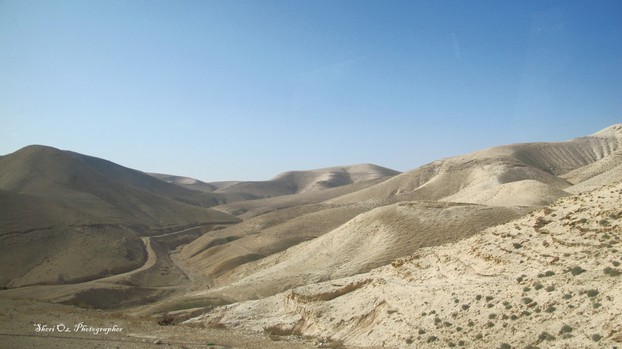 In the photo below, you can see the path of the 2-meter deep trench Israel built around Jericho during the Second Intifada in 2001 to prevent free movement of traffic into and out of Jericho. I marked it with black arrows. The city skyline is just barely visible in the distance.
  As you approach the city, you begin to see agricultural fields. Jericho is the site for growing bananas, dates, oranges and a whole variety of vegetables. One of our guides proudly told us of the Jericho orange that is apparently renowned for its special taste. I say "apparently" because he was not able to help me distinguish between the Jericho orange and other varieties in the market so I was not able to taste one for myself.
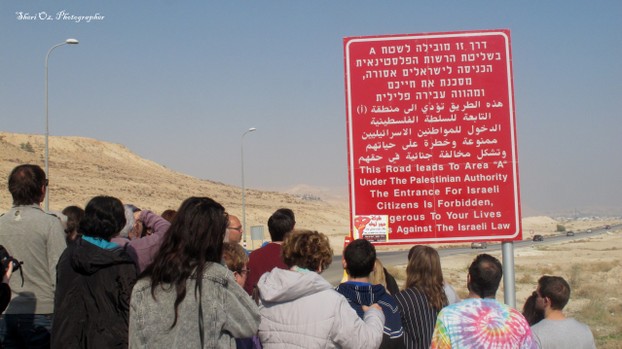 One could simply say that this sign serves as a general warning during a situation of ongoing conflict where the purpose of the government is to protect its citizens. In fact, before we could go on this trip we had to sign a waiver, acknowledging that we knew we were entering a conflict-zone and releasing IPCRI of responsibility if something were to happen to any of us. Insulting it may be, to seem to paint each and every Palestinian Arab with the terrorist
  brush, but prudent to be careful where not everyone (to put it mildly) adheres to a code of nonviolence. At the official border to the city, there is a check-post that is only sometimes manned by PA security officers. On this day, we simply drove past the barrier with nobody to stop and question us.
Entering the City of Jericho
Just inside the city we find one of the refugee camps. There are two in the area. It appears that there were over 20,000 refugees in each of these camps between 1948 and 1967, but during the 6-Day War in 1967, thousands fled from Jericho into neighboring Jordan as the Israeli army approached. Currently there are only a fraction of the refugees remaining in the camps, something that has alleviated the pressure of crowding in Jericho. This big key represents the keys to the homes the Arabs left in 1948. To me, it is shameful that such a huge population is kept in limbo, pawns in a political game that we Israelis have no intention of losing. Instead of building new lives for themselves in the places in which they are now living, they are, in a manner of speaking, sitting on their luggage. Wasted lives.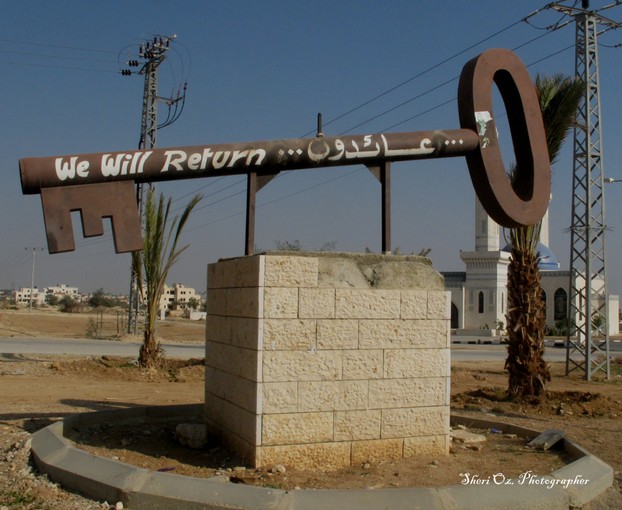 Husam told us that there were 3 reasons why Arabs left their homes in 1948 when war broke out, the war that became Israel's War of Independence and the Arab Nakba (Catastrophe):
- Because other Arab states and the Arab leadership told people to leave the area in order to let them push the Jews into the sea, after which time they will return to their homes. [I was glad to hear that he included this as one of the reasons.]
- During the organized exodus of Arabs from the towns of Lod and Ramla on orders from Ben Gurion; and
- Many fled out of fear after the massacre at Deir Yassin (where about 100 out of 600 residents of this town were killed by an Israeli paramilitary group). [There is a debate about this event.]
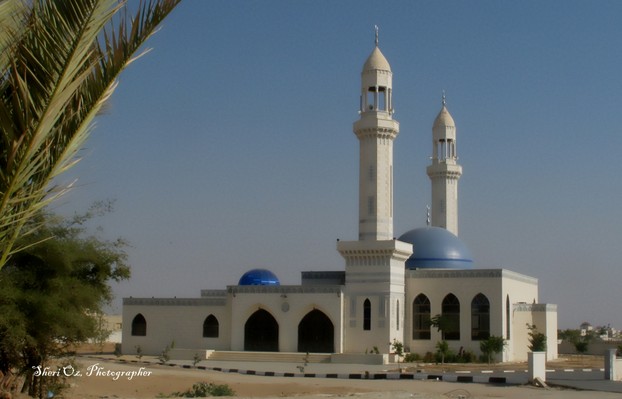 At this point of our trip, we were joined by Osama Elewat, a resident of Jericho. He co-led the group with Husam from this point on.
The Ibrahim Yagi Mosque, pictured above, was built with private donations to serve the refugee camp, Aqbat Jaber.
House Demolitions
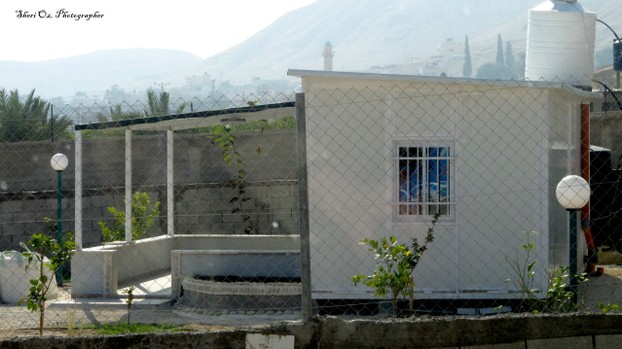 photo will NOT be demolished since it conforms to the old Ottoman law that the British accepted and that remains on the Israeli law books, whereby a building without a cement roof is considered a temporary construction and not liable for being torn down. (Wood is not used in construction in this part of the world.) Incursion of Israeli Control Into Jericho
 I found a UN map on the Internet, and in seeking permission to use the map from the UN office in Israel, I was sent the updated map you see here, with permission to include it in this article. On the map, the grayish area is Area C, the yellow is Area A and the brownish colour shows Area B. The brownish areas are occupied by Israeli settlements. I've marked out Jericho with a black border and our route from Jerusalem is the blue arrow.
Some say the next war will be over water
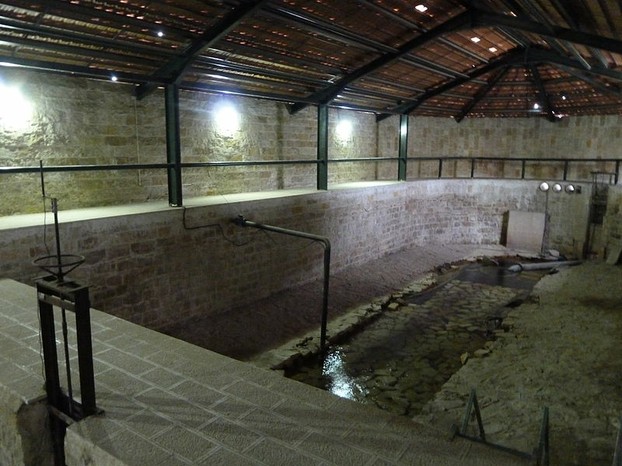 We next went to visit the enclosed water channel, called Ein El Sultan. While it appears on lists of tourist attractions, I am not sure why tourists, other than those who are politically oriented, would be interested in it. Osama and Husam told us that the once abundant agriculture of Jericho was well supplied with water and now, with the water being controlled by Israel, much of it is diverted to Israeli settlements. Therefore, Jericho's farmers are not able to produce what their land once yielded. In fact, they claimed, some of the lucky Palestinians who are able to find work, work in the settlements. This sounds so unjust. However, what they failed to mention is that Palestinian Arabs are stealing water from the pipeline, wasting water, that the Palestinian Authority has refused to build the infrastructure they agreed to do according to the Oslo Accords and for which they were given funds by the EU, and that they are illegally disposing of sewage in ways that pollute the environment. Making up lies is great for propaganda when there is nobody around to challenge you. I wish I had read this article before going on that trip so I could have asked challenging questions. I would be very interested to hear how they would have responded.
Political Jericho Over - Now We Do Some Sightseeing
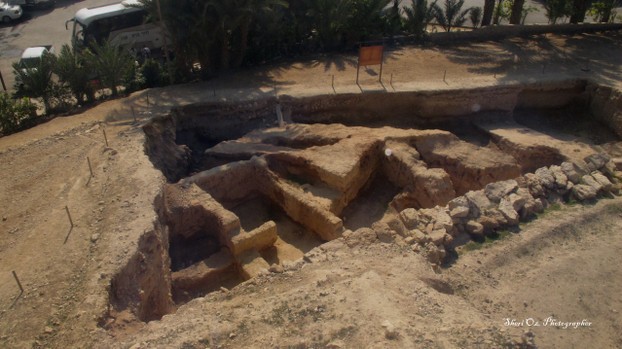 Ruins of ancient Jericho[/caption] [caption id="" align="aligncenter" width="622"]
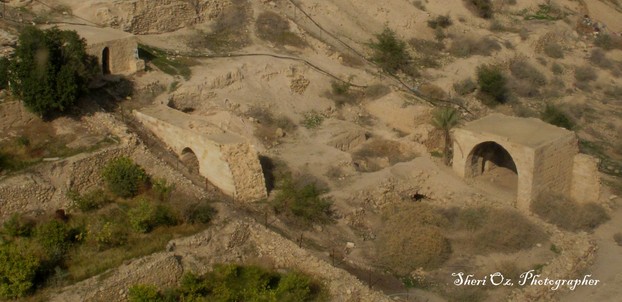 Jericho Sugar Mill[/caption]
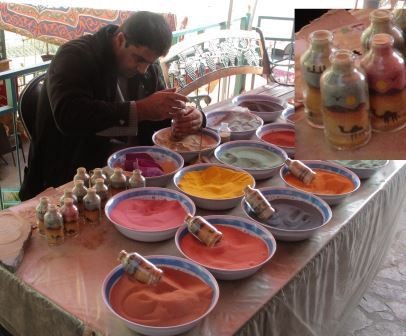
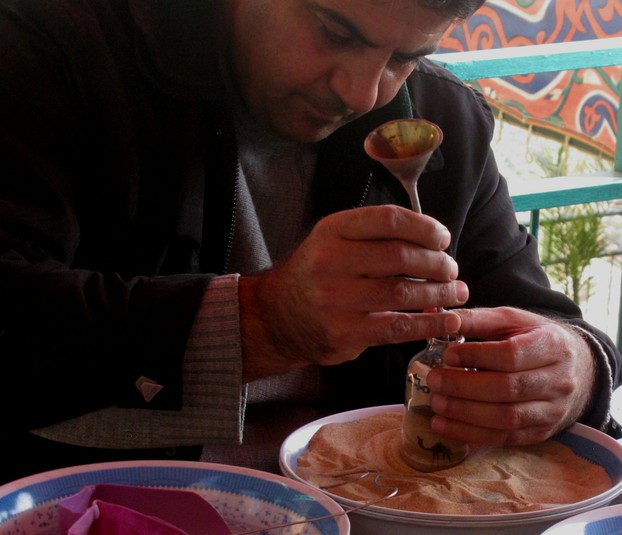
View of the Monastery on the Mount of Temptations
I took this photograph from the cable car as we were back on our way down from the Mount to Jericho.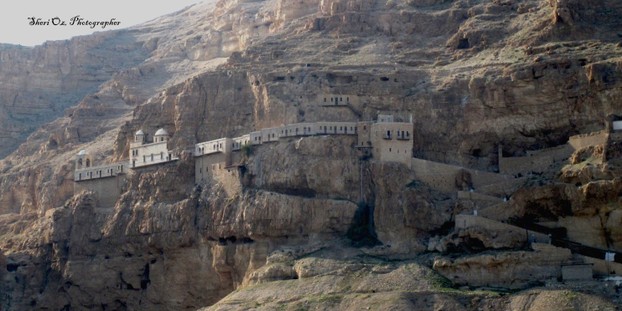
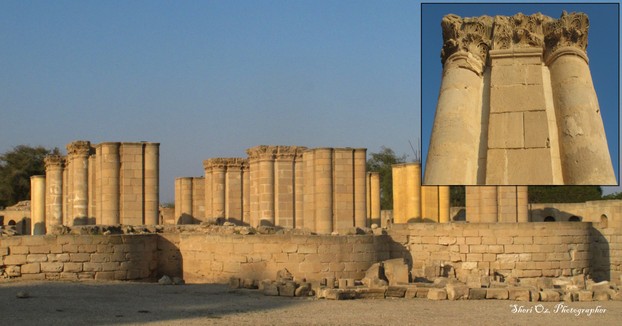 Columns in the large courtyard[/caption] [caption id="" align="aligncenter" width="622"]
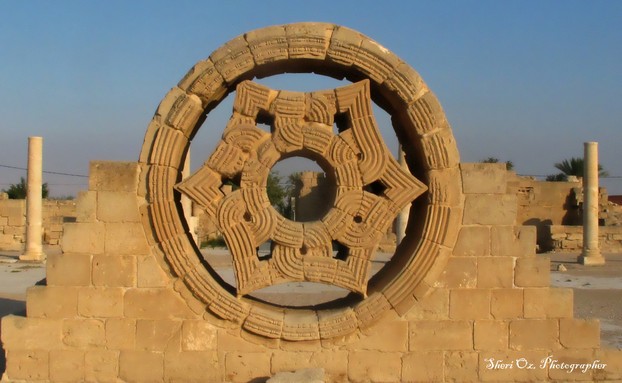 Window - A Major Architectural Masterpiece[/caption]
My Impressions of the Trip
Hisham's Winter Palace Greek Orthodox MonasteryStreet Corner
&
Other Touristy Sites In The Jericho Region
This is an amazing region, full of history ranging from the ancient 10,000-year-old city through Biblical times and repeated conquests coming from a variety of directions (Persia, Syria, Turkey, Rome, Greece) and the latest Israeli-Palestinian conflict. There are other sites to see, such as the ancient synagogue, the Baptismal spot where there is also a Greek Orthodox monastery Qasr al-Yehud, Deir Hajla - the Monastery of Saint Gerasimus, who tamed a lion by removing a thorn from its paw, and more.
Discussion (0)
No comments yet. Be the first to share your thoughts!
Leave a Comment