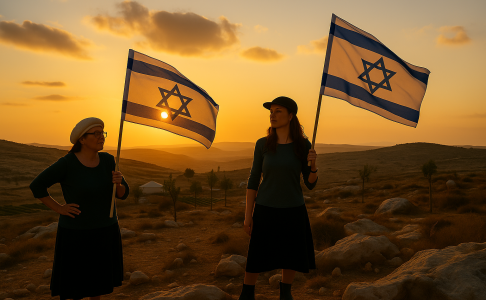
In the months since October 7, one idea has moved from the margins to the mainstream: sovereignty. But this shift did not begin in 2023 or 2024. It began decades earlier, with two women—Yehudit Katsover and Nadia Matar—whose stories trace the arc from Hebron’s rebirth to a national movement demanding that Israel finally apply its own laws to its own land.
In a three‑part series on Substack, I documented this evolution: from Katsover’s early life and the Beit Hadassah sit‑in, to the turning point that birthed the Sovereignty Movement, to Matar’s uncompromising vision for the future. What follows is an abridged version of that trilogy.
Part 1: Yehudit Katsover and the Hebron Sit‑In
Part 1 begins with Katsover’s childhood in Romania, her family’s aliyah, and her early years in Dimona and Kiryat Arba. The turning point came in 1979, when she joined twelve other women and their children in the Beit Hadassah sit‑in—an audacious act that reestablished Jewish presence in Hebron for the first time since the 1929 massacre of the Jews by their neighbours.
They climbed through a window at night, carrying mattresses, food, and babies. They lived for a year without electricity or running water, under the protection of a simple order: “Whoever is inside stays.” Their presence was legalized only after six yeshiva students were murdered in 1980.
Katsover went on to work in education for two decades, witnessing firsthand the ideological fractures within Israeli society. The expulsion from Gush Katif in 2005 broke something in her—and set the stage for the next chapter.
Key takeaway:
Katsover’s life is a bridge between the pioneers of Hebron and the modern sovereignty movement. Her activism was rooted not in protest, but in presence—physical, moral, and historical.
🡒 Read Part 1 on Substack
Part 2: The Turning Point — From Hilltops to Sovereignty
Part 2 recounts the moment Katsover met Nadia Matar of Women in Green. Together, they spent years reclaiming state land hill by hill, fighting foreign‑funded encroachment with almost no resources.
But in 2011, during yet another tree‑planting after Arab activists uprooted Jewish saplings, Katsover dropped her tools and said:
“Enough is enough.”
They realized that settlement alone could not win the war for Judea and Samaria. The real battle was political: sovereignty.
They studied land law, maps, and deeds. They fought illegal construction with facts, not slogans. They exposed the massive foreign funding behind Palestinian Authority land grabs. And they concluded that Israel’s failure to apply sovereignty after 1967 created the vacuum that Oslo later filled.
After October 7, Katsover argued, the ideological Left collapsed. The massacre shattered the illusion that coexistence could be built on denial.
Key takeaway:
The Sovereignty Movement was born not from ideology but from exhaustion—from watching the map change while Israel hesitated. Katsover and Matar reframed the struggle: sovereignty is not a dream. It is the missing piece.
🡒 Read Part 2 on Substack
Part 3: Nadia Matar and the Case for Sovereignty Now
Part 3 centers on Nadia Matar’s vision. For her, sovereignty is not annexation but the restoration of Israeli law to the Jewish heartland. She rejects partial steps:
“Ultimately sovereignty must be applied over all of Judea, Samaria, the Jordan Valley, and Gaza.”
She argues that Oslo’s framework must be nullified, that Areas A/B/C are obsolete terms, and that Israeli control is the only way to prevent future massacres. She cites demographic studies challenging Palestinian Authority numbers and insists that Israel must maintain an overwhelming Jewish majority.
Matar envisions a model in which hostile populations relocate voluntarily, while loyal minorities receive residency—not citizenship—based on international precedents from Guam to the Dutch Caribbean.
After October 7, she says, Israelis understand that wherever Israel is not sovereign, jihadist forces fill the vacuum.
Key takeaway:
Matar’s message is blunt: sovereignty is not aggression. It is clarity. It is the only way to prevent another October 7.
🡒 Read Part 3 on Substack
Why This Trilogy Matters Now
For decades, sovereignty was dismissed as fringe. Katsover and Matar were treated as outliers. But history has caught up with them. Their stories—rooted in Hebron, sharpened by Gush Katif, and vindicated by October 7—explain why sovereignty is no longer a slogan but a national imperative.
Israel cannot afford temporary control or conditional legitimacy. It cannot outsource its future to foreign diplomats or NGO-funded maps. The Jewish people live in Judea and Samaria, defend it, build it, and bury their dead there. The law must reflect that reality.
👉 Subscribe to my Substack newsletter to follow my new essays and access all full‑length pieces, including extended interviews, analysis, and research: Israel Diaries - The Deep Dive
Discussion (0)
No comments yet. Be the first to share your thoughts!
Leave a Comment