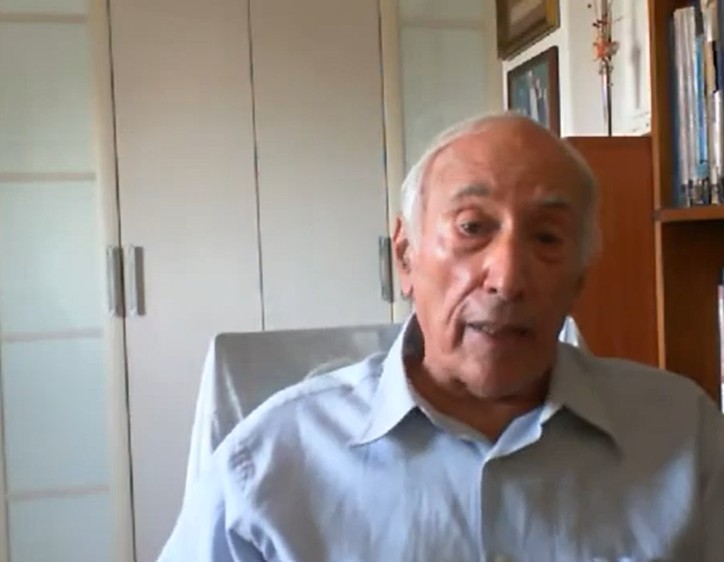
Would Palestinian Arabs accept any new political model at all that would offer a chance for a healthier future? To explore this question, I spoke with senior Arab affairs correspondent Pinhas Inbari, who argues that deep internal divisions and militia dominance make Gulf‑style governance impossible and that only local economic structures can challenge the PA.
After watching a panel discussion in which senior Arab affairs correspondent Pinhas Inbari described the vast differences among Arabs in Israel and the PA, I asked him what he thinks might work to solve the Israel-Palestinian conflict..
We spoke on Zoom last week. Inbari respects Kedar but believes the Gulf model he promotes cannot work here. The Gulf states are far more homogeneous and their sheikhs enjoy broad consensus. They also have oil and gas, which means prosperity and stability. Our neighbors in the PA do not.
I challenged him, noting that even Palestinians from respected families have carried out suicide attacks. Inbari responded by describing Islam in the UAE. Their model is tolerant. At the Islamic Museum in Sharjah, he saw how Islam was presented as part of world culture, philosophy and science. That is why the Abraham Accords were accepted so naturally there.
Why the Gulf Model Cannot Work in the West Bank
In the West Bank, he said, every city has clans that fight each other. These clans are crime families. The Barghouti family in Ramallah is the largest and today they are Hamas. You cannot build a political solution on crime families. Their struggle is not about what kind of state they want but what kind of fight they will wage against Israel.
Israel wants stability. If Israel quietly builds an element inside the West Bank that competes with the militias, there is a chance to achieve it. That means supporting trade and commerce. The private sector wants stability. They do not want intifadas or Gaza‑style destruction.
Arafat understood this. He saw the private sector as a threat to his jihadist mindset. He persecuted merchants, monopolized the economy and directed it toward the struggle. Inbari recalled meeting an expat from Beit Jala after Oslo. The man refused to invest because PA leaders reminded him why he had left. The PA did not want a private sector it could not control.
Commerce as a Counterweight to the Militias
From the beginning, Inbari argued that Israel must work around the PA because the PA sabotages everything. The key is the Chambers of Commerce. He described visiting one city where all the clans united to prevent the PA from taking over the Chamber. The office displayed the required photo of Abu Mazen, but the walls were filled with photos of meetings in Amman and the Gulf. The Chamber had more power than the mayor.
Funds for business grants exist but have been frozen for years out of fear the PA would steal them. These funds could be reopened, with Israeli intelligence vetting applicants and money going directly to business owners through Chambers not controlled by the PA.
I asked about terrorists demanding protection money. Inbari said it will take time to eliminate that. Patience is required.
What This Approach Leads To
Inbari was clear. This will not lead to a Palestinian state. Palestinians do not want one. They have told him the PA is the occupation. Arafat did not come to make peace. He came to destroy Israel. Israel’s mistake was trying to solve a problem it did not have. Judea and Samaria were ours. We should have protected what we had.
Israel needs quiet. The world needs to forget the Palestinian problem. That happens by promoting the economy quietly, behind the scenes.
No Political Solutions, Only Practical Ones
Any political proposal will be rejected. Extending sovereignty would ignite the region. Israel must act, not talk. Help build a reality in which economic success is preferable to fighting. Political moves only strengthen the militias.
On antisemitism, Inbari said Palestinian society is not inherently antisemitic. The education system is. It must be changed, and the UAE curriculum is a model.
You can read the full indepth Substack version of this article here.
👉 Subscribe to my Substack newsletter to follow my new essays and access all fulllength pieces, including extended interviews, analysis, and research: Israel Diaries – The Deep Dive
Discussion (0)
No comments yet. Be the first to share your thoughts!
Leave a Comment