Debates about Palestinian identity often jump from one question to another: if Palestinians are a people, does that automatically entitle them to a state? The article begins by noting that many readers accepted that “the ‘Arafat‑was‑born‑in‑Cairo‑so‑there‑is‑no‑such‑thing‑as‑Palestinians’ argument is weak,” yet quickly shifted to a new challenge: “Does that mean they are entitled to a state?” This assumption, the article argues, misunderstands how peoplehood and statehood actually relate.
The article opens by recalling a previous argument: Yasser Arafat’s Cairo birthplace does not disqualify him as a Palestinian. Many readers accepted this point, but immediately raised a different question: “Fine. Suppose we accept that Palestinians are a people. Does that mean they are entitled to a state?”
The assumption that peoplehood naturally produces statehood is widespread. For some, this belief may even underlie the reluctance to acknowledge Palestinians as a national group. But the article argues that this assumption is historically inaccurate and analytically unhelpful.
Public debate often becomes tangled in genealogy — birthplace, surnames, or claims of indigeneity — as if national identity were a matter of bloodlines. The article notes that modern peoples demonstrate the opposite. Jews, whose surnames “often shifted under pressure,” Americans, whose surnames “overwhelmingly come from elsewhere,” Argentinians, largely descended from Italian and Spanish immigrants, and Turks, whose surnames were assigned only in 1934, all show that identity is not determined by ancestral purity.
Reader Zev Spitz offers a useful framework: broad identities such as Arab or Muslim, narrow identities such as clan or tribe, and “middle identities,” the modern national identities that sit between them. Jordanians can be Arab, Muslim, and Jordanian. Egyptians can be Arab, Muslim, and Egyptian. “So why should Palestinians be unable to be both Arab and Palestinian?”
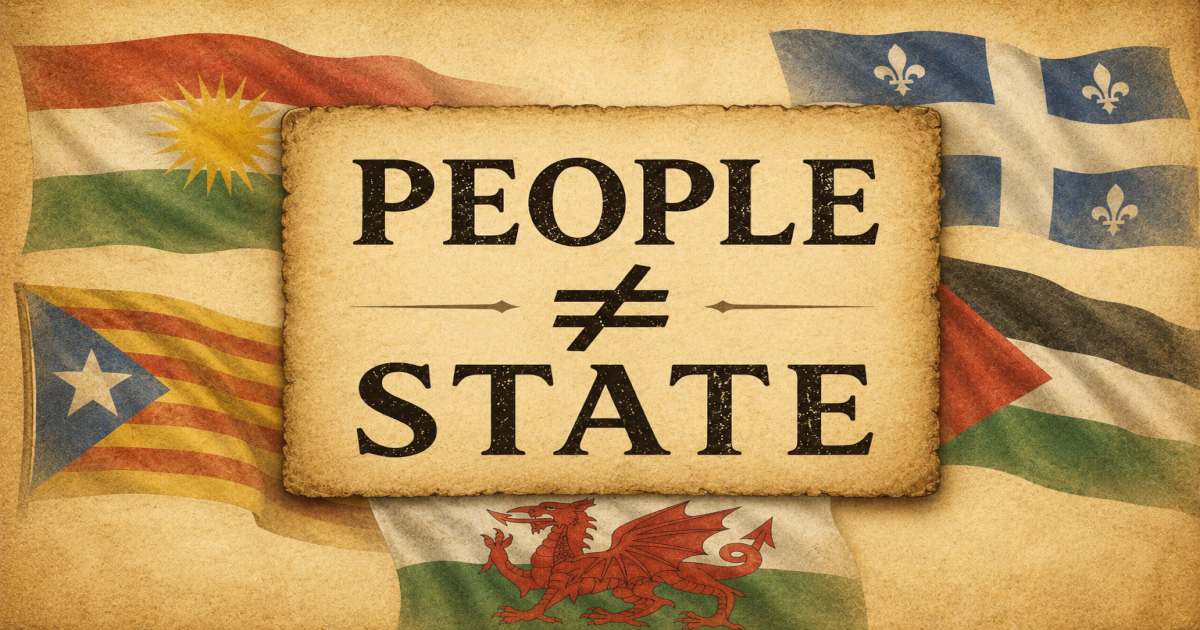
Even if we grant Palestinian peoplehood, the article stresses that statehood is a separate issue. “While peoplehood and statehood are related, they are not the same thing.” Some peoples achieve states; others do not; and the reasons vary. The article includes a table to illustrate this diversity, emphasizing that it is descriptive rather than analogical.
Beyond the examples in the table, the article lists Scots, Welsh, Corsicans, Baloch, Chechens, Tamils, Sikhs, and Kashmiris as peoples who have maintained distinct identities without achieving sovereign statehood. These cases do not mirror the Palestinian situation; they simply show that peoplehood and statehood do not always align. Historically, statehood has depended on political, territorial, and international conditions, not solely on the existence of a distinct people.
The existence of a people may explain why aspirations for self‑determination arise. But it does not determine “if, nor how, those aspirations must be realised.”
The article then turns to why this distinction matters. The Israeli‑Palestinian debate often collapses multiple questions into one. One side argues: “There is no Palestinian people; therefore there is no need to talk about a Palestinian state.” The other argues: “There is a Palestinian people, therefore there must be a Palestinian state.” Both positions conflate identity with sovereignty.
A more productive discussion requires separating the issues. We can acknowledge that “there are millions of people who identify as Palestinians.” That fact alone does not make a sovereign state inevitable. Recognizing Palestinian identity does not predetermine the political outcome. It simply clarifies the starting point for any serious conversation about the future.
You can read the full in‑depth Substack version of this article here.
👉 Subscribe to my Substack newsletter to follow my new essays and access all full‑length pieces, including extended interviews, analysis, and research: Israel Diaries – The Deep Dive
Discussion (0)
No comments yet. Be the first to share your thoughts!
Leave a Comment