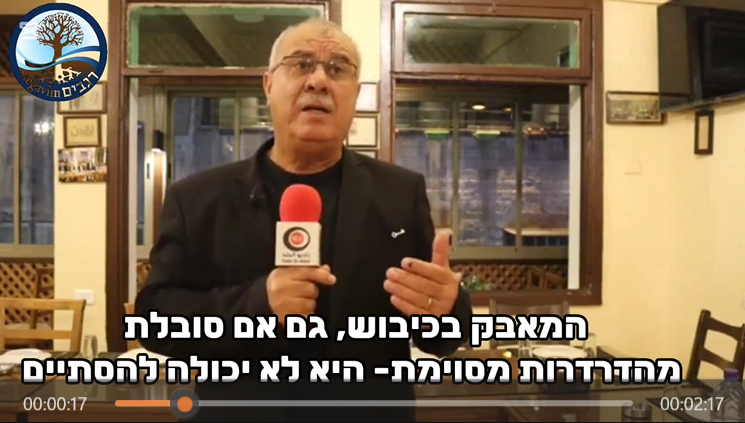
Former MK Mohammad Barakeh has repeatedly praised violent resistance against Israel, encouraged Arab citizens to join the Palestinian struggle, and appeared alongside extremist figures — yet Israeli authorities have consistently declined to act against him. This article examines Barakeh’s recent statements, his legislative record, and the broader pattern of legal and political leniency that raises serious questions about whether Israel enforces its own laws when the incitement comes from Arab leaders.
Israelis often note that some Arab politicians speak differently in Hebrew and English than they do in Arabic. At times, the mask drops even in Hebrew, such as when MK Ahmed Tibi eulogized terrorists from the Knesset podium in 2022. Yet no disqualification followed. The law allows the Knesset election committee to bar candidates who deny Israel’s legitimacy, incite racism, or support terrorism, but the Supreme Court has consistently overturned disqualifications of Arab candidates while upholding those against Jewish extremists. This article does not challenge the latter — only the asymmetry.
Mohammad Barakeh, a former Hadash MK, exemplifies this disparity. Despite statements at a Birzeit University conference urging Israeli Arabs to join the Palestinian struggle, his candidacy was never challenged. The same leniency appears in the state’s response to his recent activities.
Barakeh’s Jordan Speech and Regavim’s Complaint
At a December 2024 conference in Jordan titled “Supporting Palestine,” Barakeh praised “mukawameh” — violent resistance — and said Hamas represents a significant portion of the Palestinian people. He agreed with a Jordanian official who argued that Palestinians must “infiltrate Israeli society” and fight Zionism from within.
Regavim submitted a detailed letter to the Attorney General requesting a criminal investigation. They argued that Barakeh’s statements constitute support for terrorism, incitement to violence, and encouragement of Israeli Arabs to join armed struggle — all violations of Israel’s Anti‑Terrorism Law. They requested action within 14 days. Whether they will receive a response remains unclear.
His Legislative Record — and the Benefits of Office
Barakeh served five Knesset terms between 1999 and 2015. Nine of his 462 proposed bills became law, mostly early in his career and focused on social and economic issues consistent with communist ideology. Many of his unsuccessful bills sought to undermine core elements of Israel’s identity and sovereignty, including canceling the Law of Return, reversing the annexation of the Golan, and redefining Arab citizens as part of the Palestinian people.
Despite his anti‑state rhetoric, he received a generous separation grant and receives a pension funded by Israeli taxpayers.
The Real Question: Will the System Ever Act?
Israel has the legal tools to address incitement and support for terrorism, but not the will. Courts and political institutions have repeatedly declined to enforce consequences when Arab leaders openly support violent resistance. Regavim’s complaint may test whether that will ever change.
Removing leaders who glorify violence could open space for Arab Israelis who reject Barakeh’s path. But that requires a justice system willing to act. So far, it has not.
You can read the full in‑depth Substack version of this article here.
👉 Subscribe to my Substack newsletter to follow my new essays and access all full‑length pieces, including extended interviews, analysis, and research: Israel Diaries – The Deep Dive
Discussion (0)
No comments yet. Be the first to share your thoughts!
Leave a Comment