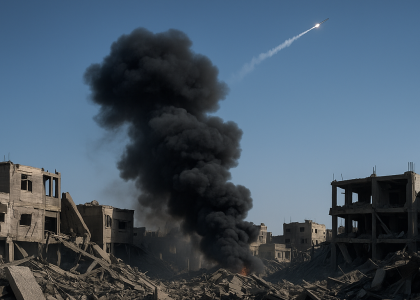
A Comment That Shifted the Frame
I recently posted a brief Note: “How does Bibi expect to defeat Hamas if he is negotiating with Hamas?” As I typed, a missile alert sounded in southern Israel—militants in Gaza had launched two rockets. I was frustrated, angry, and still thinking about the sirens when a commenter named Mike responded. He ignored the question of negotiations and the rockets entirely. Instead, he wrote: “Israeli airstrikes killed at least 60 Palestinians, including 22 in a single attack on a crowded café.”
I don’t know if he meant to shame me. What I do know is that his comment instantly shifted the focus from ceasefire talks and attacks on Israelis to rubble in Gaza. Rather than deflecting, I followed that shift. His comment led me into research that uncovered not only the story of that café but the broader pattern of how violence is reported, judged, and morally assigned in this war.
Mike was referring to the Israeli airstrike on a Gaza seafront café that reportedly killed around 30 civilians, according to The Guardian and AP. Coverage was somewhat muted, likely due to ongoing ceasefire negotiations, but HonestReporting documented how headlines still distorted the facts and accused Israel of deliberately targeting journalists, women, and children. Without the pressure of hostage talks, this incident would likely have followed the familiar script: emergency sessions at the EU and UN, a wave of moral outrage, and front‑page images of bloodied bodies and grieving families.
When Israeli Victims Disappear
This pattern extends far beyond one exchange. When Hamas fired ten rockets at southern Israel in April, and when Hezbollah fired 80 rockets into the north in November 2024—deliberately targeting civilians—there were no emergency meetings, no international statements of moral outrage, no front‑page profiles of victims. The only time Israeli victims have received sustained humanizing coverage was after the Oct 7th massacre and during hostage‑release ceremonies. But Oct 7th was an atrocity so shocking that even a cynical international media could not ignore it.
It should not take a massacre to merit empathy.
How Headlines Shape Moral Judgment
The difference is not just in tone; it reveals a deeper asymmetry in how legitimacy, law, and victimhood are assigned. To test whether my impressions held up, I turned to AI’s language analysis tools to compare framing, tone, and terminology across coverage.
The results were stark.
When rockets fall on Israeli cities, headlines often read like weather reports—short, factual, and quickly displaced by Israel’s military response. For example: “Iran fires fewer than 100 missiles at Israel; most intercepted, Israeli military says.” The phrasing is clinical, detached, as if “fewer than 100 missiles” is routine data.
When Gaza is struck, the story begins with the civilian impact. One headline read: “Israel strikes pound Gaza, killing 60, ahead of US talks on ceasefire.” Within the article, it specifies: “Twenty‑two people, including women, children and a local journalist were killed in an Israeli airstrike on a beachfront cafe in Gaza City.” The imagery is vivid, emotional, and morally charged.
These disparities are not accidental. They stem from deeply entrenched assumptions about who is expected to follow the rules of war and who is excused from them.
Why the Asymmetry Persists
Several factors drive this imbalance. Israel is a state, and Hamas is a non‑state actor. States are held to legal norms that terrorists ignore. Yet this distinction is rarely acknowledged by international bodies or media. Palestinians are often cast as eternal victims of “occupation,” the colonized party in a post‑colonial morality play. This framing excuses or justifies the “underdog’s” violence, denies them agency, and lowers expectations for their adherence to international law.
And, of course, images of urban devastation and mourning families make for far more dramatic reporting than photos of smoke trails where a missile was intercepted before hitting the ground.
Why It Matters
When the global response teaches terrorists that targeting civilians carries no cost, while defending against those attacks invites censure, international institutions and media embolden terror, reward the use of human shields, and delegitimize deterrence. This is not just hypocrisy. It is complicity. When only one side is held accountable, the rules of war become weapons.
You can read the full in‑depth Substack version of this article, complete with tables and sources, here.
👉 Subscribe to my Substack newsletter to follow my new essays and access all full‑length pieces, including extended interviews, analysis, and research: Israel Diaries - The Deep Dive
Discussion (0)
No comments yet. Be the first to share your thoughts!
Leave a Comment