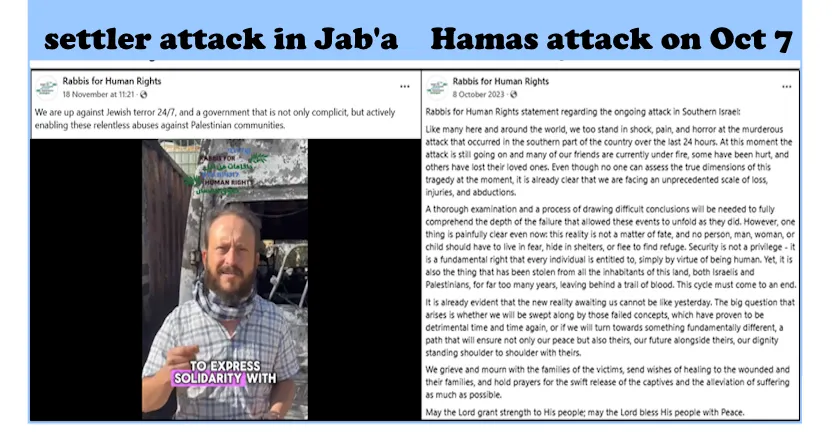
After the 17 November 2025 attack in the Palestinian village of Jab’a, several Israeli NGOs quickly labeled the incident a pogrom, an act of terror, and even compared the attackers to Hamas’s Nukhba commandos. Yet these same organizations avoided such language after the October 7, 2023 massacre, despite its scale and brutality. This article examines how NGOs framed Jewish violence versus Hamas violence and what those choices reveal.
After the 17 November 2025 attack in the Palestinian village of Jab’a, Peace Now posted early and described the incident as state‑backed terror. They accused settlers of arson and severe property damage, helping establish one of the harshest moral frames applied to the event. Their language was categorical, immediate, and morally maximalist.
The contrast with their response to October 7, 2023 could not be sharper. On that day, Hamas murdered approximately 1,200 people, burned families alive in their homes, and abducted 251 civilians to Gaza. Yet Peace Now’s first post after the massacre avoided naming Hamas altogether. Instead, they framed the catastrophe in abstract political and moral terms, focusing on “vision,” “responsibility,” and “concepts,” rather than on perpetrators, atrocities, or victims.
This asymmetry is not incidental. Peace Now’s English‑language messaging regularly labels settlers as “terrorists” and describes their actions as “state‑backed terror.” This is how they delegitimize settlers in international eyes, and they are entirely comfortable using that terminology abroad. But their Hebrew messaging after Jab’a went even further.
The word “pogrom” carries specific weight in Israel. It describes organized mob violence against Jews. Applying it to settler attacks is already charged. But Peace Now escalated further in Hebrew, and only in Hebrew, equating the Jab’a attackers with the Nukhba commandos who led the Oct 7 massacre. They used a slangy, Hebraized plural — נוכבות — a term that exists entirely within Israeli social discourse. Israelis immediately hear “Nukhba” in it because the word has been seared into national consciousness since the massacre. The subtext is unmistakable. But anyone outside Israeli life, however fluent their Hebrew, would likely miss the reference. The term does not appear in dictionaries; even Google Translate cannot process it.
In English posts about the same incident, Peace Now never used an equivalent loaded term. The coded language was reserved for Israelis alone. Reading it two years after Oct 7, the emotional resonance is immediate and devastating. It is difficult to believe an Israeli NGO would go this far, and I checked the text repeatedly before including it here.
Their first post after Oct 7 featured a photo of Noa Argamani’s father pleading for his daughter’s return — with no mention of Hamas, who was holding her. The contrast between the images accompanying their first Jab’a and Oct 7 posts is striking.
Peace Now represents the extreme end of a broader pattern. But the split between how Jewish versus Hamas violence is framed appears across all six NGOs examined in this series: B’Tselem, Rabbis for Human Rights (RHR), Standing Together, Tag Meir, and Zazim. Across the board, Jewish attackers receive maximal moral language; Hamas receives passive, abstract, or conceptual language.
The differences in RHR’s posts are equally stark. Their first Jab’a post featured a graphic video of a burned vehicle and direct attribution of Jewish “terror.” Their first post after Oct 7 contained no images at all, despite the abundance of available documentation. Instead, they posted a polemic about political vision, shared responsibility, and the need to rethink “failed concepts.”
This is especially striking given that RHR’s CEO, Avi Dabush, spent nearly nine hours in his safe room in Kibbutz Nirim during the Oct 7 attack, with Hamas terrorists all around. One might have expected this terrifying experience to influence his language. It did not.
As documented in previous articles in this series, vehicles were burned in Jab’a; however, no photographic evidence of burned homes emerged, even when NGO members visited four days later with ample opportunity to document fire damage. Yet the language of “burned homes” persisted.
In one video, Dabush stands inside a home showing nothing worse than a broken window while narrating claims of homes having been burned. Meanwhile, homes were burned in the Gaza Envelope on Oct 7 — the very homes Peace Now did not call a pogrom, and the burned structures RHR described in terms of “failed concepts” and “political vision.”
None of the six NGOs used the word “pogrom” for Oct 7 in the first week after the massacre.
You can read the full in‑depth Substack version of this article here.
👉 Subscribe to my Substack newsletter to follow my new essays and access all full‑length pieces, including extended interviews, analysis, and research: Israel Diaries - The Deep Dive
Discussion (0)
No comments yet. Be the first to share your thoughts!
Leave a Comment