By the time the Jab’a incident entered international coverage, reports described dozens or even hundreds of settlers rampaging through the village, burning homes while families hid inside. Yet the publicly available images and videos tell a far narrower story. This article examines what the physical record can independently verify. And where the evidence stops.
By the time the Jab’a incident entered the international news cycle, its contours already seemed fixed. Headlines spoke of a pogrom. Reports described dozens, and in some accounts even hundreds, of settlers rampaging through the village, setting homes ablaze while families hid inside. These descriptions circulated quickly and widely, crossing languages, platforms, and political contexts with remarkable consistency.
This article asks a narrower question: What does the publicly available physical record actually show? Not what witnesses experienced, not what attackers may have intended, and not what moral judgments the incident deserves. Only what the images and videos themselves can independently support.
Across this series, I have traced how claims were introduced, amplified, and stabilized. Part 1 examined how captions framed meaning before evidence was examined. Part 2 showed how Arabic‑language media expanded scope and scale without adding documentation. Part 3 mapped contradictions across NGO timelines. Part 4 compared NGO labeling of Jab’a as a pogrom with their mild labeling of Oct 7th. Part 5 turns to the material record itself.
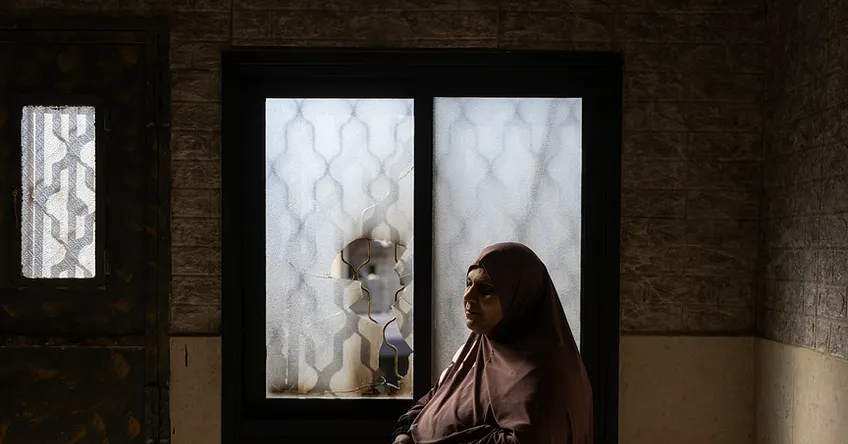
One resident is repeatedly quoted as a primary witness. His testimony describes attackers entering the home and attempting to set it on fire. Testimony documents lived experience. But when testimony concerns physical processes like fires and structural damage, it requires physical corroboration. The publicly available images associated with the house he identifies as his son’s do not show evidence of interior fire damage. The images consistently depict exterior damage and a burning vehicle in the compound. They do not document fire inside living spaces. This discrepancy does not negate the testimony. It defines its evidentiary limits.
The visual record related to Jab’a is surprisingly narrow given the scale of claims made. A small number of videos and photographs appear repeatedly across NGO posts, media reports, and activist accounts. These visuals carry most of the narrative weight. One site is the residential compound where a van was filmed burning at night from an elevated balcony. This balcony video is the most widely circulated image of the incident and was repeatedly used when implying attempted arson of an inhabited home. A separate CCTV video, filmed elsewhere in the village and first shared by B’Tselem, shows a stoned vehicle and one that was torched. Public reporting often refers to “multiple sites” without specifying how many. Based on the visual record alone, only these two distinct locations can be identified.
With the assistance of OSINT analyst Tal Hagin, architectural indicators were compared across night‑time and daytime imagery. This placed the balcony from which the video was shot in the compound later visited by NGO activists and claimed to be the site of attempted arson. Indicators include the distinctive iron banister design, balcony geometry, window placement, and spatial relationships between the building and courtyard. The B’Tselem footage shows a metal frame protruding from the parking garage, distinguishing it from the garage next to the house in the balcony‑video site. Repeated use of imagery from the same structure across different reports creates the impression of multiple affected homes when, in fact, the visuals cluster around two locations.
Across the available footage, four vehicles were independently identified and consistently documented: the burned van in the balcony video, a burned car in the same compound, and two cars in the B’Tselem video—one stoned, one torched. These four vehicles meet basic verification criteria: each appears in multiple frames or angles, each can be placed spatially, and each is associated with fixed architectural markers. Additional images of burned vehicles circulated online but cannot be tied to these locations through overlapping angles or timestamps. Excluding them is a methodological requirement, not a judgment about authenticity.
The balcony video shows a van burning in a residential compound at night. Flames illuminate the courtyard and nearby walls. This footage is repeatedly paired with claims that settlers attempted to burn homes with families inside. +972 Magazine published testimony describing the direct use of accelerants inside a living space. That account is not corroborated by the available physical documentation. Interior ignition typically leaves specific signatures: soot deposition, heat warping, secondary ignition, smoke migration patterns. These indicators are absent in the images and videos made public. Broken windows alone do not support interior ignition.
From the publicly available material, it can be confirmed that there were ignition events at two distinct locations in Jab’a. Four vehicles were damaged, three by fire. The proximity of the fires to the two homes was frightening but did not spread to the homes themselves. These findings establish an evidentiary ceiling beyond which claims are not supported.
One of the most striking aspects of the Jab’a coverage is the abandonment of field verification by domestic media. Israeli outlets repeated claims without on‑site verification: no independent identification of locations, no confirmation of damage patterns, and no reconciliation of inconsistencies. Once the frame was established, verification became optional.
Claims about incidents like Jab’a are routinely used to define broad patterns of settler violence. That makes evidentiary precision especially important. Physical evidence does not resolve narrative disputes. It constrains them. That constraint was absent here.
You can read the full in‑depth Substack version of this article here.
👉 Subscribe to my Substack newsletter to follow my new essays and access all full‑length pieces, including extended interviews, analysis, and research: Israel Diaries - The Deep Dive
Discussion (0)
No comments yet. Be the first to share your thoughts!
Leave a Comment