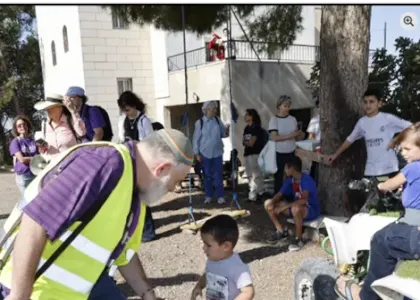
Following the 17 November 2025 attack on the Palestinian town of Jab’a, Israeli NGOs quickly issued statements describing a pogrom, Jewish terror, and burned homes. Yet the images they shared, both on the night of the attack and during later solidarity visits, never showed fire‑damaged houses. This gap between language and documentation is the focus of this case study.
On 17 November 2025, young Jewish hoodlums entered the Palestinian town of Jab’a near Bethlehem. They vandalized property and frightened residents. But within hours, Israeli NGOs described the incident using terms that their own photographs never substantiated (pogrom, terror, burned homes), even after they later walked through the village freely.
This review covers every Facebook post about Jab’a published between 17 and 24 November 2025 by six Israeli NGOs: B’Tselem, Peace Now, Rabbis for Human Rights, Standing Together, Tag Meir, and Zazim. Their X and Instagram accounts were also checked; all posts duplicated Facebook content and added no new images or claims. In total, 25 posts appeared during this period.
The earliest and most influential claims came from Peace Now. Around 19:30 on 17 November, three videos circulated: a brief CCTV clip later republished by B’Tselem; balcony footage of a burning vehicle; and a video posted by Ilhab Hassan showing a burning vehicle, an adjacent small structure, and flames against the exterior wall of a nearby house. These clips formed the visual basis for the immediate proclamations of a “pogrom” by one NGO and “Jewish terror happening in real time” by another.
At 19:41, Peace Now posted the balcony video and wrote that “Jewish terrorists are setting houses on fire in the territories.” An hour later, they posted a still from the Hassan video showing the burning vehicle and attached shed. No home appears in that image. In subsequent posts announcing a solidarity visit, they wrote that settlers had “set homes on fire” and “burned homes.” Yet none of their posts included images of burned houses.
Although Peace Now introduced the “burned homes” claim, the phrasing spread quickly across the NGO ecosystem. Their visual documentation, however, consisted only of the burning vehicle and the adjacent shed. The fire against the house wall in Hassan’s clip was not shared. When Peace Now visited the village on 21 November and had the opportunity to photograph fire damage to any home, they did not.
By 20 November, multiple organizations were using variations of the burned‑homes claim. By 21 November, every major activist organization posting about Jab’a was using nearly identical language. The escalation came from repetition, not new evidence.
Some claims faded quickly. The assertion that residents were forced to flee disappeared. But the burned‑homes claim persisted, despite the lack of documentation. One frame in Hassan’s video may have been interpreted as a house on fire, but NGOs never used that frame, and when they spoke of burned homes, they showed burned vehicles instead.
The solidarity visit on 21 November drew over 100 Israelis. Tag Meir’s photo gallery from that day shows marchers, banners, a group shot in front of the burned van, and activists standing with residents in front of intact homes. Everyone who entered the village had ample opportunity to photograph fire damage to houses. None did. Photos that some later claimed showed soot stains will be examined separately.
A Channel 13 broadcast on the evening of 17 November amplified the “burned homes” claim, with the anchor describing “arson on houses” while airing the same limited footage used by NGOs: the balcony video and Hassan’s clip. No unique on‑site imagery of home interiors or structural fires was shown. Follow‑up reports did not revisit or substantiate the home‑arson angle, despite open access to the village.
In the week following the incident, no Israeli or international mainstream outlet—Times of Israel, Jerusalem Post, Haaretz, Reuters, AP—published images of fire‑damaged Palestinian homes in Jab’a. The visual record remained confined to vehicles and a proximity fire.
If the core force behind calling the incident a pogrom lay in the accusation of houses set on fire—a claim fundamentally different from torching cars—then NGOs repeated the claim without evidence. Hassan’s video showed the most dramatic imagery available, yet NGOs either did not share it or cropped out the fire burning near, not in, the house. Activists walked through the village with phones in hand and returned with photographs of burned vehicles and none of burned homes. No one updated their posts.
You can read the full in‑depth Substack version of this article here. It includes an appendix with all source materials.
👉 Subscribe to my Substack newsletter to follow my new essays and access all full‑length pieces, including extended interviews, analysis, and research: Israel Diaries - The Deep Dive
Discussion (0)
No comments yet. Be the first to share your thoughts!
Leave a Comment