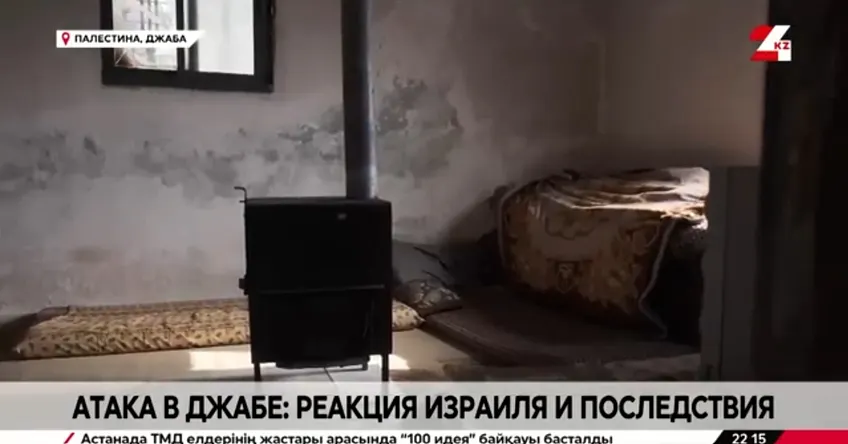
When the Jab’a incident entered Israeli and international news cycles, claims of burned homes and large‑scale arson spread rapidly. Yet Israeli television coverage never followed those claims with independent on‑site verification even though Jab'a is a short drive away from television studios.
Parts 1–5 of this series examined what happened in Jab’a, how claims were formed, and what the physical evidence does and does not show. This final part turns to a different question: how Israeli domestic media handled the event. Within hours of the incident, the narrative had already hardened. Claims of burned homes and widespread arson circulated widely. Politicians condemned. NGOs amplified. International outlets reported. What did not follow, at least in publicly aired Israeli television coverage, was independent on‑site verification of those claims.
An i24 News broadcast on November 17 reported that “cars and even some homes were set on fire.” The phrasing was cautious, reflecting what was being claimed at the time. The footage accompanying the segment clearly showed burned vehicles. What it did not show was independently verified interior structural fire damage inside a residential home. In breaking‑news environments, early claims are often transmitted with caveats. The expectation is that verification will follow. In the case of Jab’a, no such verification occurred.
Reuters sent a team to Jab’a that night. Their footage documented multiple burned vehicles, including interior vehicle damage. They interviewed residents. They filmed a woman inside a supposedly fire‑damaged home. They included official Israeli statements and Palestinian accounts. But as Part 5 established, interior residential fire indicators—soot deposition, heat warping, burn patterns—were not visually documented in Reuters’ same‑night field report or in NGO next‑day reporting. Being physically present is not the same as demonstrating the specific physical claims being narrated.
When domestic outlets do not conduct independent, clearly contextualized verification, a vacuum forms. Foreign broadcasters then interpret the available imagery through their own frameworks. In one Russian‑language broadcast, moisture damage inside a house was presented as evidence of structural fire destruction. The error was not necessarily malicious. It was interpretive. A Russian crew may not recognize moisture staining common in older homes in this climatic region and instead interpreted what they saw through the assumption of fire damage. If domestic reporting does not define the physical reality precisely, others will define it imprecisely.
Responsible verification would not have been difficult. Jab’a is approximately thirty minutes from Jerusalem. A television crew could have visited the compound where the balcony video was filmed, entered the alleged burned structure, and filmed interior walls, ceilings, and structural elements in daylight. Such footage would have quickly resolved the central physical claim. Either it did not happen or it was not aired. Instead, the public conversation relied on night footage, activist clips, NGO statements, and second‑hand narration.
Jab’a did not become a case study in contested claims where facts were inaccessible. It became a case study in narrative inertia.
In high‑tension environments, verification must escalate proportionally to the claim.
This series has not argued that no damage occurred. It has not denied that vehicles were burned or that residents experienced vandalism and fear. It has examined something narrower and more structural: how claims are formed, transmitted, and solidified, and how an entire population can be vilified in the process. In Jab’a, the verification that could have presented the incident in its true proportions never took place. And once the decision to forgo independent field verification was made, even cautious phrasing becomes hardened fact.
That is the precautionary lesson—not about one village or one outlet, but about what happens when institutions stop asking to see proof for what agenda‑driven bodies are saying. And that includes Prime Minister Netanyahu, who condemned the incident within hours, before he had any way of knowing what had happened in Jab'a.
You can read the full in‑depth Substack version of this article here.
👉 Subscribe to my Substack newsletter to follow my new essays and access all full‑length pieces, including extended interviews, analysis, and research: Israel Diaries - The Deep Dive
Discussion (0)
No comments yet. Be the first to share your thoughts!
Leave a Comment