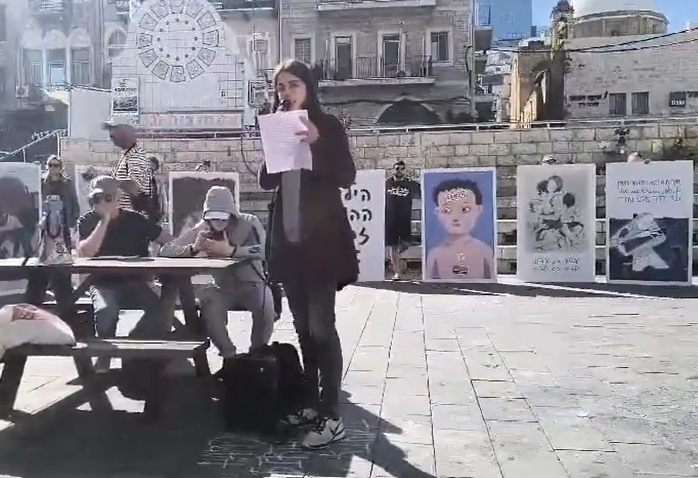
During a demonstration in Haifa, an Israeli activist ended her speech by shouting at a counter‑protester: “You are a stinking Nazi.” The outburst, directed at someone defending the IDF, raises uncomfortable questions about how fringe Israeli groups frame the war and the army. This article examines the incident, the organization behind the protest, and the broader implications of amplifying or ignoring such rhetoric.
At a small demonstration in Haifa, an activist reading a testimony from a Palestinian child was heckled by a counter‑protester. Her response was explosive: “And you support child murder. You are a stinking Nazi.” Angry outbursts often bypass filters, revealing what people truly think. She could have chosen dozens of insults. She chose that one. And she chose it while speaking about the IDF.
What the demonstration claimed to be
The group’s Facebook post described the event as a vigil reading testimonies from “four theaters of war: Israel, Gaza, the West Bank, and Lebanon.” They framed Israel as killing, starving, deporting, and abusing children across the region, while also acknowledging Israeli children displaced by war. Their message: all suffering is Israel’s responsibility, because Israel controls everything.
But the post omitted Hamas, Hezbollah, October 7th, and the thousands of rockets fired at Israeli civilians. It blamed only Israel. It also inflated attendance, described participants as reading “in tears,” and labeled counter‑protesters as “Ben‑Gvir activists.” The framing was clear: they see Israel as the aggressor, the IDF as the perpetrator, and themselves as moral witnesses.
What actually happened on the ground
In reality, there were perhaps twenty activists, roughly the same number of police, and only a few passersby who stopped to listen. No one appeared to be reading in tears. The counter‑protesters were ordinary Israelis, not political operatives. And the organization’s narrative erased the context of the war entirely.
Should this be publicized?
This is the dilemma. Publicizing such incidents risks giving fringe groups more attention than they deserve. It also risks providing ammunition to anti‑Israel activists abroad who love to quote Israelis who call the IDF “Nazis.”
But ignoring it has its own cost. These groups operate inside Israel, speak in Israel’s name, and spread narratives that erase October 7th and absolve Hamas and Hezbollah of responsibility. Their rhetoric influences public discourse, especially online. Exposing their words helps Israelis understand the internal sources of delegitimization and self‑hatred that fuel external attacks.
You can read the full in‑depth Substack version of this article here.
👉 Subscribe to my Substack newsletter to follow my new essays and access all full‑length pieces, including extended interviews, analysis, and research: Israel Diaries – The Deep Dive
Discussion (0)
No comments yet. Be the first to share your thoughts!
Leave a Comment