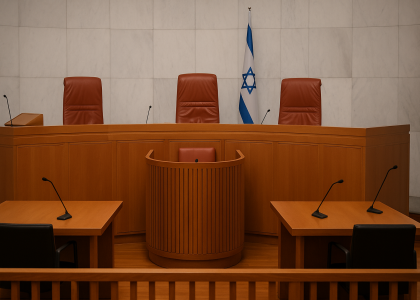
Israel has not carried out an execution since Adolf Eichmann in 1962, yet the legal authority to execute terrorists remains fully intact. This contradiction — a death penalty preserved in statute but never applied — exposes a deeper conflict inside Israel’s system of governance, where laws are passed but the bureaucracies responsible for enforcing them often decline to act.
Israel’s Death Penalty Framework
Israel executed Adolf Eichmann in 1962, a moment that symbolized both justice delivered and justice restrained. His hanging was carried out quietly, and it marked the last time the state used its ultimate punishment. Since then, Israel has convicted terrorists responsible for atrocities, yet not one has faced execution. This is not because the law forbids it. It is because the state refuses to use the authority it already has.
While Israel abolished the death penalty for ordinary murder in 1954, it preserved capital punishment for wartime crimes and acts of extreme national harm. Article 96 of the Penal Code explicitly authorizes execution for wartime atrocities, and military law in Judea and Samaria contains parallel provisions. The Nukhba terrorists who raped, burned, and butchered Israelis on October 7 committed their crimes during wartime. Under existing law, they are eligible for execution. Yet none will face it according to current legislation.
How Prosecutors Block Capital Punishment
This contradiction came into sharp focus on 28 September 2025, when the Knesset Internal Affairs Committee convened during recess to debate new death‑penalty legislation. The timing was fraught: hostage families waited for news of loved ones still in Gaza, and even discussing executions risked influencing negotiations. National Security Minister Itamar Ben‑Gvir demanded a mandatory death sentence for terrorists, while others warned that the debate itself could endanger lives. Bereaved families argued that executions could deter future kidnappings.
Former IDF prosecutor Adv. Maurice Hirsch sees the debate as part of a larger reckoning. In his view, Israel’s paralysis is not moral restraint but a collapse of governance. The legal framework exists, yet prosecutors hold an effective veto. In the early 1970s, when two military courts imposed death sentences, the High Court overturned both, ruling that capital punishment could be applied only if prosecutors explicitly requested it at the start of trial. That procedural requirement became a permanent barrier.
Over time, this evolved into a bureaucratic system designed to prevent executions. Cases that fall under military jurisdiction — where the death penalty applies — are quietly transferred to civilian courts, where it does not. Prosecutors who attempt to seek capital punishment face internal pressure or removal. Charges are narrowed to avoid invoking wartime clauses. The result is a legal structure that appears functional but is engineered to ensure that the death penalty remains theoretical.
The Debate Over Deterrence
New legislation mandating execution for terrorists does not solve this. Prosecutors still control which charges are filed and which jurisdiction is used. Even if a death sentence were imposed, it would require executive approval, and every such sentence in Israeli history has been commuted. Hirsch points to a 2023 law stripping citizenship from terrorists who receive Palestinian Authority payments — passed 94–10, the most consensus legislation in Israel’s history — yet never implemented. For him, this is not restraint but institutional refusal to enforce the law.
Security officials often argue that executions would increase kidnappings. Hirsch rejects this, noting that terrorists already kidnap because they expect Israel to release prisoners alive. If prisoners were not available for exchange, the incentive would diminish. He also argues that most terrorists seek to survive in order to kill again, making the threat of execution a potential deterrent.
Governance vs. Bureaucracy
Legal scholar Smadar Ben‑Natan offers a different interpretation. She sees Israel’s refusal to execute as a deliberate moral stance, a national identity shaped by the memory of genocide. By executing Eichmann and no one else, Israel created a symbolic hierarchy of evil: Nazi genocide at the top, Palestinian terrorism beneath it. In her view, restraint is intentional, a way for the state to assert moral sovereignty.
What Ben-Natan sees as identity, Hirsch sees as abdication. The divide reflects a larger question: who defines the state — elected lawmakers or entrenched legal bureaucracies? For now, the law exists. Israel refuses to use it. And in that gap lies the question of what kind of state Israel chooses to be.
Discussion (0)
No comments yet. Be the first to share your thoughts!
Leave a Comment