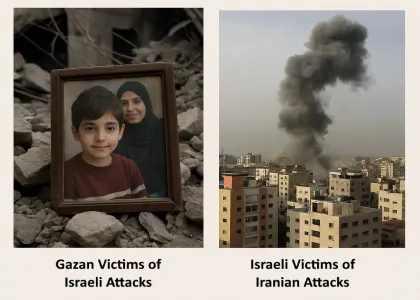
International coverage of Iran’s April missile barrage against Israel exposed a pattern that has become impossible to ignore: Israeli victims of violence are rarely given names, faces, or human stories, while Gazan casualties are consistently profiled with emotional depth and institutional urgency. When Iranian missiles evaded interception and killed Israelis, global reporting focused on military technology, regional escalation, and structural damage. This asymmetry—in media framing, legal scrutiny, and moral storytelling—distorts global understanding of the conflict and determines whose suffering is allowed to matter, and whose is quietly absorbed into statistics.
When Iran launched more than 300 ballistic missiles at Israeli cities last month, I wondered whether the global response would finally break the pattern. Here was a state‑sponsored attack on civilians, an unambiguous act of aggression. Surely this time, the international community and the media would treat Israeli victims with the same humanizing attention routinely given to Gazans.
I had recently examined how international institutions and major outlets apply legal scrutiny, moral outrage, and emotional storytelling to Israeli military actions, while describing Hamas attacks in strategic or morally neutral terms. As I wrote then: the only time Israeli victims receive sustained humanizing coverage is after a mass atrocity like October 7th or during hostage releases. It should not take a massacre to merit empathy.
I turned to AI‑driven language analysis to compare institutional reactions to Iran’s missile barrage with reactions to Israeli strikes in Gaza—and to compare how Israeli and Gazan casualties are portrayed. The results were depressingly consistent.
Institutional asymmetry
Table 1. International Response: Iran’s Missile Attack vs. Israeli Airstrikes in Gaza
|
Aspect |
Iran’s April 2024 Missile Attack |
Israeli Airstrikes in Gaza |
|
Condemnation |
General calls for restraint; Israel’s right to defend acknowledged¹ |
Strong and specific legal condemnation of civilian harm² |
|
Legal Framing |
Rarely described as war crimes³ |
Frequently discussed as potential war crimes and collective punishment⁴ |
|
Emergency Sessions |
One UNSC session, no resolution⁵ |
Multiple UNSC and UNHRC meetings, resolutions on Gaza⁶ |
|
Investigative Calls |
No formal international investigations⁷ |
Regular calls for ICC involvement and official inquiries⁸ |
|
Media Framing |
Focus on military tech, interception success, regional escalation⁹ |
Focus on civilian death tolls, destroyed homes, personal stories¹⁰ |
The contrast is unmistakable. Iran’s coordinated missile assault—aimed at civilians—generated muted, procedural responses. Israel’s targeted strikes in Gaza, by contrast, triggered immediate legal condemnation and demands for accountability. The presumption of legitimacy runs in only one direction: Israel is assumed guilty; its enemies are treated as geopolitical actors whose violence is regrettable but unexamined.
Whose lives are told, and whose are counted
In view of the multitude of human-interest stories about Gazan victims, I asked AI to find international human‑interest stories about Israeli victims of the missile barrage. It found three: a short Reuters piece about a family from the Arab village of Tamra; a two‑minute AP video of an 18‑year‑old woman’s funeral; and an AP article about a Ukrainian immigrant whose home was destroyed. That was all. When I asked for an in‑depth, 800‑word human interest story about any Israeli victim, the answer was simple: none exist in the international press.
In the Israeli press, there were lists of the dead—names, professions, fragments of their lives—but even there, no long‑form profiles. No portraits of who they were before they were murdered.
Narrative placement and memory
Meanwhile, for Gazan victims, such pieces are standard. A typical example: “A boy with a brain injury fights for his life in Gaza’s decimated health system.” We learn about his injury, his pregnant mother’s death, his father’s grief, his aunt’s vigil. The story is rich with quotes, photos, and emotional detail.
AI’s comparison of human‑interest patterns showed the same divide: Israeli victims are occasionally named but rarely described; images show funerals or rubble, not the person alive; their stories appear deep in the article, if at all; and there is no follow‑up, no memorialization. Gazan victims, by contrast, are introduced with emotional recollections, shown in pre‑death portraits, placed at the center of the narrative, and revisited in later coverage. Their stories become part of the world’s moral vocabulary.
The Israelis killed by Iran’s missiles had names. Most of the world will never know them.
You can read the full in‑depth Substack version of this article, including tables and sources, here.
👉 Subscribe to my Substack newsletter to follow my new essays and access all full‑length pieces, including extended interviews, analysis, and research: Israel Diaries - The Deep Dive
Discussion (0)
No comments yet. Be the first to share your thoughts!
Leave a Comment