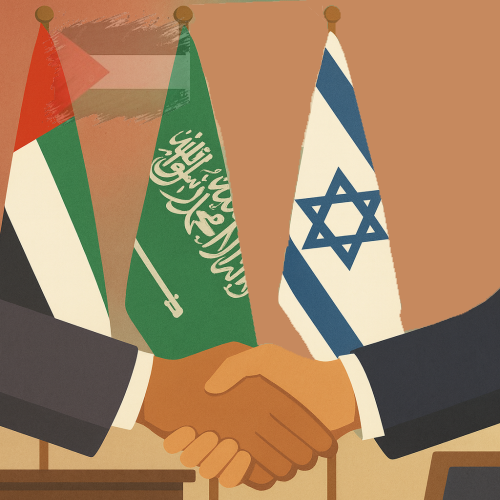
While global headlines focus on Gaza’s devastation, Gulf states are quietly expanding trade and technological cooperation with Israel, signaling a profound shift in regional priorities. UAE‑Israel commerce grew 11% between 2023 and 2024, and similar patterns appear across Bahrain, Morocco, and even Saudi Arabia. This realignment reflects not temporary wartime pragmatism but a deeper transformation in how the Arab world increasingly sidelines the Palestinian question.
For years, international media have framed Gaza as the emotional core of Arab politics. Yet while bodies are counted in Gaza, UAE customs officials count profits from trade with Israel — trade that grew 11% between 2023 and 2024. Commerce continues across technology, tourism, and agriculture despite public backlash. This is not an anomaly. It is the clearest sign of a regional shift: the quiet abandonment of the Palestinian cause by the Arab world’s most influential states.
The Abraham Accords were expected to collapse under the pressure of a crisis like October 7th. Instead, they strengthened. UAE‑Israel trade surged from pre‑2020 levels of tens of millions to $3 billion in 2023, continuing to grow during the war. The Abraham Accords Peace Institute reported that Bahrain’s trade with Israel increased almost 900% in the first seven months of 2024, with Morocco up 64% in the first five months. Their summary was blunt: “Abraham Accords ties break new records, remain steady after October 7.”
Saudi Arabia’s behavior is even more revealing. Publicly, the kingdom issued ritual condemnations, affirming its “categorical rejection of calls for the forced displacement of the Palestinian people from Gaza” and denouncing attacks on civilians. Yet behind the scenes, cooperation deepened. Israeli technologies in artificial intelligence, cybersecurity, and solar energy are already embedded in Saudi development projects, even though the official Vision 2030 website avoids mentioning Israel.
Intelligence coordination also continued. Israel received advance warning of Iran’s April attack through Saudi channels. The land corridor established in December 2023 through Saudi Arabia and Jordan still transports goods threatened by Houthi attacks on Red Sea shipping routes. The pattern is unmistakable: public condemnation paired with private cooperation.
Private firms, wary of boycott campaigns, have stepped back from publicized ventures such as the Saudi‑Israeli solar energy project announced in August 2023, which has seen no updates since October 2023. But governments continue to engage. Unlike the UAE or Bahrain, Saudi Arabia has not formally joined the Abraham Accords, making its quiet alignment even more politically significant.
The strategic logic driving Gulf decisions has little to do with Palestinian liberation. Iran containment remains the top priority, and Israel offers intelligence, defense technology, and strategic coordination unmatched by any Palestinian entity. Economic diversification requires partnerships with global technology leaders, and Israel’s innovation ecosystem serves Gulf development goals in ways Palestinian institutions cannot. Hamas’s October 7th attack reinforced Gulf leaders’ view of Palestinian militant groups as threats to regional stability, not champions of justice.
This new environment means Palestinian factions can no longer rely on unconditional Arab support. Palestinian maximalism can no longer dictate Arab development. And Palestinian statehood is no longer a prerequisite for Arab‑Israeli normalization.
The question is whether Western policymakers will recognize this shift or continue to base their diplomacy on a fiction that even its supposed champions have abandoned.
You can read the full in‑depth Substack version of this article here.
👉 Subscribe to my Substack newsletter to follow my new essays and access all full‑length pieces, including extended interviews, analysis, and research: Israel Diaries – The Deep Dive
Full Series
- The Gulf States have moved on from Palestine
- Statehood? Not so fast The Gulf’s real attitude to Palestine
- Neighbours Egypt and Jordan privately oppose Palestinian statehood
- Diplomacy’s Denial: American and the peace process that is not
- Europe loudly says “Palestinian state.” Under its breath: “not really.”
Discussion (0)
No comments yet. Be the first to share your thoughts!
Leave a Comment