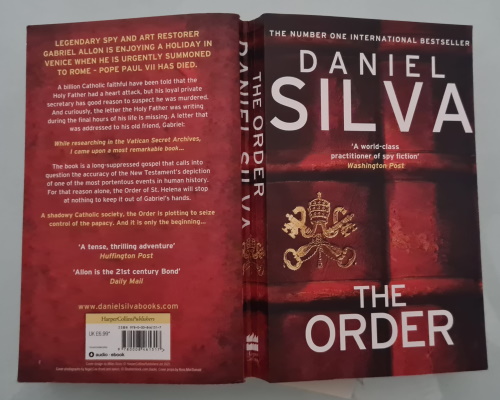
Daniel Silva’s thriller The Order places the origins of Christian antisemitism at the heart of its plot, weaving a story that challenges foundational Christian narratives while delivering the international intrigue Silva is known for. Reading it during Israel’s war against Hamas, with global Jew‑hatred surging, made its themes feel especially sharp.
In Daniel Silva’s novel The Order, the origins of Jew‑hatred are not just a theme — they are a main character. As I read, I imagined that many believing Christians would hate this book. Reviews confirmed my suspicion. Not because Silva highlights centuries of Christian antisemitism rooted in blaming Jews for Jesus’ death, but because the novel dares to challenge the very foundations of Christianity. Critics were polite, but the discomfort was clear.
Silva calls his genre “international intrigue,” and this novel fits perfectly. The Order is the twentieth book featuring Gabriel Allon, the Israeli intelligence officer with near‑limitless resources. Allon is vacationing in Venice when he is summoned to Rome by Luigi Donati, an archbishop and close confidant of the pope. The pope has been found dead. Donati believes it was murder and asks Allon to uncover the truth.
The plot includes additional murders as the perpetrators try to protect their secret. Some scenes stretch credibility — particularly one deep in the Vatican library — but the characters are well‑drawn, the dialogue sharp, and the pacing accelerates from a gentle start to a gripping final act. It is artfully written, and I thoroughly enjoyed it.
Reading it now, four months into Israel’s war against Hamas, with the world accusing Israel of defending itself “too” forcefully and Jew‑hatred raging globally, the novel’s direct confrontation with antisemitism felt like a relief.
One conversation stood out. On page 260, Allon meets Eli Lavon in Munich. Lavon asks why antisemitism is rising again in Europe, why Jews are unsafe, why the shame of the Holocaust has faded. Allon answers with “nine words.” Those words — “His blood be on us and on our children” — come from Matthew 27:25, a verse that has fueled centuries of Christian Jew‑hatred.
Silva invents a fictional “Gospel of Pilate,” a report that would have exonerated the Jews had it not been hidden. In the novel, the pope discovers this document in a secret Vatican archive and intends to give it to Allon. That discovery becomes the motive for his murder. This is revealed early, so it is not a spoiler. Knowing it does not diminish the suspense.
Historical exposition can bog down thrillers, but here it works. Silva integrates these sections smoothly, and they are essential for understanding the characters’ motivations. I found them compelling rather than intrusive.
Throughout the book, I wondered about Silva himself. Writers are told to write what they know. Silva clearly knows both Christianity and Judaism intimately. He grew up Roman Catholic, married a Jewish woman, converted to Judaism, and raised his children as Jews. This dual familiarity gives the novel an authenticity it could not otherwise have.
Personally, I finished the book wishing the fictional “Gospel of Pilate” really existed. Had such a document been known in the early decades after Jesus’ death, would Christianity have developed differently? Would a new religion have arisen that effectively cursed the one from which it emerged?
Silva’s novel does not answer these questions, but it raises them boldly. And in a time when Jew‑hatred is again erupting worldwide, The Order feels not only timely but necessary.
You can read the full indepth Substack version of this article here.
👉 Subscribe to my Substack newsletter to follow my new essays and access all fulllength pieces, including extended interviews, analysis, and research: Israel Diaries – The Deep Dive
Discussion (0)
No comments yet. Be the first to share your thoughts!
Leave a Comment