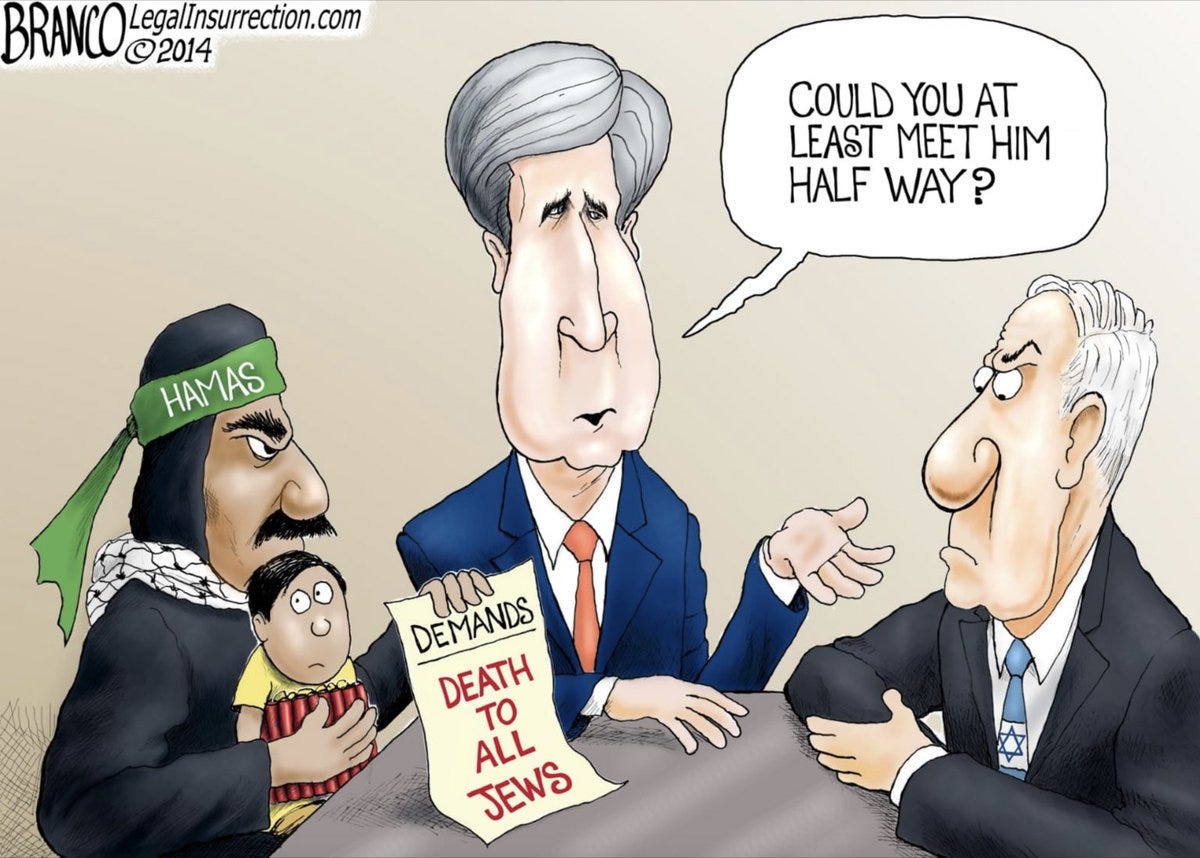
John Matthews recently published an article titled “The Ultimate, Definitive Peace Plan,” offering yet another foreign blueprint for how Israel should resolve its conflict with the Arabs‑who‑now‑call‑themselves‑Palestinians. While his intentions are sincere, his proposal reflects the same misunderstandings that plague most outsider peace plans: a lack of historical grounding, a misreading of Arab society and a failure to grasp Israel’s legal and strategic realities.
John Matthews’ boastfully titled “Ultimate, Definitive Peace Plan” joins a long line of well‑meaning proposals written by people who want peace but do not fully understand the conflict. Some still cling to a two‑state solution, others to federations or confederations, all trying to balance Israel’s security and demographic concerns. They overlook the fact that “compromise” with genocidal jihadists is impossible.
Before addressing Matthews’ specific claims, it is important to note a major reason foreigners feel entitled to instruct Israel: Israel has not been clear enough about the fact that Gaza, Judea and Samaria and the Temple Mount are Israeli territory. When Israel extended sovereignty over the Golan Heights after 1967, the world complained but ultimately accepted it. Had Israel done the same elsewhere, we would not now be in the humiliating position of outsiders telling us how to manage Gaza.
Matthews also seems unaware that in July 2024 the Knesset voted overwhelmingly against establishing a Palestinian state, even as part of a negotiated settlement. Sixty‑eight MKs supported the resolution, including members of Gantz’s centrist party. Only nine opposed it. Forty‑three abstained, including Yesh Atid and parties further left. Matthews claims MKs across the spectrum support his plan, but the vote tells a different story.
Where Matthews Goes Wrong
First, Matthews suggests an “exchange of prisoners‑settlers‑returnees,” allowing Israeli Jews to remain in Judea‑Samaria if an equivalent number of Palestinians settle inside Israel. This assumes a false equivalence. On one side are Arabs who fled when five Arab armies invaded the nascent Jewish state and lost. On the other side are Jewish communities rebuilt after Jordan’s illegal occupation wiped them out in 1948, only to be liberated in 1967 when Jordan again tried to destroy Israel and lost. There is no “right of return” to land lost in an offensive war.
Second, Matthews acknowledges the Jew‑hatred indoctrination in Palestinian Authority schools, something released hostages described. But he ignores the fact that the cultural conditions that allowed Germany and Japan to be de‑Nazified do not exist in Arab society. Re‑education is not a realistic tool here.
Third, he proposes a six‑nation committee — the USA, Saudi Arabia, Israel, “Palestine,” Egypt and Jordan — to run Gaza and Judea‑Samaria until jihadism is eradicated. This idea stems from Israel’s failure to assert sovereignty after 1967. Because Israel did not incorporate these territories, outsiders now presume authority over them.
His suggestion that Saudi Arabia should help govern Gaza because they will fund reconstruction is misguided. Saudi Arabia is not a democracy and is not a model we want imported. Including “Palestine” — meaning the Palestinian Authority — contradicts his own admission that no country considers the PA moderate. As for Egypt and Jordan, they maintain a cold peace with Israel only because it serves their interests. Jordan relies on Israeli water and quiet support for its monarchy. Egypt relies on American aid tied to the peace agreement.
Fourth, Matthews claims that once the “destruction of Israel” is no longer a goal, terrorism will fade. This is naïve. He assumes that prosperity will override theological imperatives. This was the pre‑Oct 7th conceptzia that blinded Israel. While individual Arabs may want normal lives, the Arab street is not driven by Silicon Valley dreams.
The Real Path Forward
The only viable path begins with Israel winning the war against Hamas and other jihadist groups, followed by military occupation for as long as necessary or, preferably, full application of Israeli sovereignty. Any long‑term solution must respect Arab social structures, particularly the clan system. Under Israeli security, tribal leaders could re‑establish authority and form a local governance model similar to Mordechai Kedar’s Emirates proposal.
Before anyone proposes peace plans for Israel, they must first understand Arab society. Matthews does not.
You can read the full indepth Substack version of this article here.
👉 Subscribe to my Substack newsletter to follow my new essays and access all fulllength pieces, including extended interviews, analysis, and research: Israel Diaries – The Deep Dive
Discussion (0)
No comments yet. Be the first to share your thoughts!
Leave a Comment