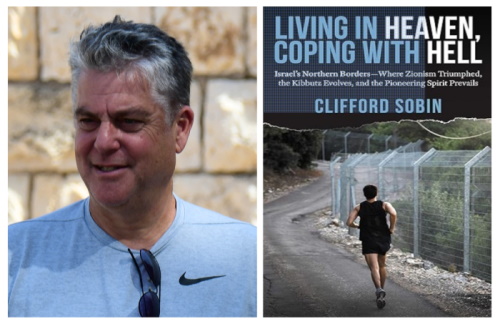
Clifford Sobin’s Living in Heaven, Coping with Hell brings Israel’s northern border communities to life with the pace of a thriller and the depth of a historical study. Reading it today, as missiles fall on the very towns he describes, makes the book feel both prescient and heartbreakingly relevant.
On page 103 of Clifford Sobin’s over 400‑page book, he describes driving up the steep road to Hanita and imagining what it felt like to build a community surrounded by people who wanted you dead. That passage stayed with me. It captures not only Sobin’s sense of wonder but also the awe I feel whenever I hike or drive through this land, knowing my ancestors walked here thousands of years ago.
Sobin’s book transforms places I have passed on the way to somewhere else into communities filled with real people I now feel I could sit with over coffee. And reading it today, when my phone vibrates daily with alerts about missile or drone attacks on those same places, makes the book even more poignant. Coffee and conversation are impossible for now.
I confess: I bought the book expecting it to be useful, not gripping. I thought it would help me see how to weave interviews into a project I’m working on. Instead, I found myself reading it in bed as if it were a mystery novel, despite its textbook size. That alone is an endorsement.
The title tells the story: Living in Heaven, Coping with Hell. The subtitle pulls you in further: “Israel’s northern borders — where Zionism triumphed, the kibbutz evolves, and the pioneering spirit prevails.” Even so, I didn’t expect to enjoy it as much as I did. Learn from it, yes. Enjoy it, absolutely.
Typing the title now brings tears to my heart. The towns and kibbutzim Sobin writes about — Kiryat Shmona, Metula, Majdal Shams, Ghajar, Degania, Dan, Hanita — are largely emptied today under missile barrages and fires. His book gives them life at a moment when they are physically silent.
Part One covers the early days of the modern state, focusing on specific communities. Part Two brings us into their present lives, introducing the people who make these places work despite the challenges.
Sobin describes how, in the 1930s, Jewish organizations shifted from buying fertile land to buying strategic land, regardless of soil or climate. Terrorist infiltrations from Lebanon made it clear that settlements were needed as defensive bulwarks. Thus the tower‑and‑stockade communities were built in the north, just as in the Negev.
His descriptions of building those settlements — the weather, the terrain, the marauding Arabs, the sheer physical exhaustion — are vivid enough to picture. Perhaps my familiarity with the landscape helps, but Sobin’s writing is what makes it come alive.
The book is grounded in research and in interviews with longtime residents. Their voices give it vitality. And it is prescient. Published in 2019, it reads as if predicting Oct 7th — except that the north experienced similar horrors long before. Sobin recounts the 2002 infiltration near Hanita, when terrorists used a trapeze ladder to “sail” over the fence without triggering sensors. They killed and maimed Israelis before being stopped.
He also reminds us of the 1974 attacks in Ma’alot, Kiryat Shmona and Nahariya — moments that remain in the DNA of the north. His description of people jolted from sleep into terror could just as easily describe Sderot or Kibbutz Be’eri today.
Yet this is not a book about fear. It is a book about life — about people who built and sustained communities through physical, political and economic hardship. Sobin’s artistry makes the far north feel intimate. I can almost imagine greeting the people he writes about as if we were old friends.
When it is safe again, I believe many Israelis and tourists will add these northern communities to their itineraries. The war has put them on the map. Sobin puts them in our hearts.
You can read the full indepth Substack version of this article here.
👉 Subscribe to my Substack newsletter to follow my new essays and access all fulllength pieces, including extended interviews, analysis, and research: Israel Diaries – The Deep Dive
Discussion (0)
No comments yet. Be the first to share your thoughts!
Leave a Comment