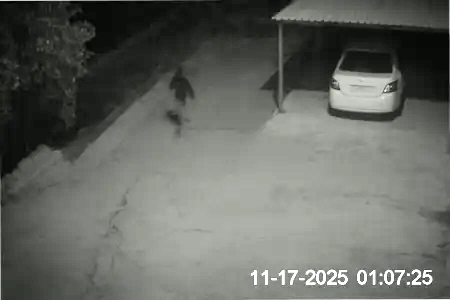
The B’Tselem video from Jab’a has been widely cited as evidence that settlers deliberately targeted a Palestinian family with young children, but a close reading of the timestamped footage tells a different story. The clip contradicts one of the most widely repeated claims in early NGO and media reports, revealing how quickly a narrative can solidify before the underlying evidence is examined. Understanding that gap is essential to understanding how “settler violence” stories grow beyond the facts on the ground.
November 17: Reports began circulating about a settler attack in the Palestinian town of Jab’a. Two days later, B’tselem posted a video clip on Facebook that was intended to provide proof that settlers deliberately target families and children, a claim expressed by a number of NGOs reporting on the Jab’a attack.
For those who followed NGO statements and local media posts in the hours and days after the Jab’a incident, the tone was set almost immediately. Each organization that issued a statement offered its own version of events, but with a common denominator: this was not only an attack, it was an attack on families, a detail that elevates any incident from property damage or intimidation to something much darker. Numbers of attackers fluctuated wildly from “dozens” to “over a hundred.” Some reports suggested that homes were set alight. Others mentioned multiple cars. Some even went as far as to say it was a pogrom.
Within hours, the event hardened into a narrative: settlers had descended on Jab’a in large numbers, targeted Palestinian families and children inside their homes.
Early reporting on “settler violence” allegations routinely relies on unverified or contradictory secondary claims. It is not unusual for social and mainstream media to parrot these reports or for Israeli politicians and officials to announce their condemnations before even a hint of preliminary investigation has been raised.
The attack in Jab’a followed this pattern. However, in the case of Jab’a, B’Tselem posted the only direct visual documentation of the attack that I could find. B’Tselem’s video evidence should have anchored the conversation. Instead, the clip was referenced sparingly and interpreted loosely, with public summaries taking their cues not from what appears on camera but from what was said about it.
The goal of this three-part series is to examine the process by which a local incident becomes a “settler violence” narrative far beyond its natural proportions. The attack was real, frightening, and inexcusable. But fear and facts are not the same thing, and if we are to understand the process at work here, we need to begin with the evidence itself.
The B’Tselem video offers a unique opportunity to do that.
Part 1 therefore begins at the narrowest possible point: a single contradiction between a caption and a video.
The Video Clip
The text accompanying the video alleges that masked settlers assaulted a car carrying two small children, their mother, and their uncle. While they do not use the exact phrase “targeting families,” the implication is clear: the attack is described as knowingly directed at a family with young children inside. The video is offered as evidence of that claim.
The video does not support any implication that the attackers intended to burn the family’s car. The moment the attackers see the child and hear the horn, they abandon the family’s car entirely and set fire to a different, empty vehicle.
This is the only continuous, time-stamped footage of the attack that I found, and it contradicts specific allegations made later that the attackers knowingly targeted a family with small children.
[insert video here]
The clip begins with masked men entering a yard. The attackers throw stones at the family car between 0:06 and 0:13, breaking at least one window. The driver honks the horn and a child is visible (0:24). Twelve seconds later, the masked men abandon that car completely. They run to a different vehicle parked in an adjacent carport and set that one on fire instead (0:48). By 0:53, all the attackers have left the scene. At 0:59, the male driver gets out of the car, soon followed by the woman holding an infant in one arm and holding a child’s hand in her other hand. By 1:24, the woman and children enter the house.
If the intention was to attack a family or to set a car alight knowing a child was inside, the available footage would show it. Instead it shows the opposite: they disengage immediately and move to an empty vehicle.
The attack damaged property and frightened people.
However, the video shows that one of the central claims of “targeting families” is not supported by the only real-time evidence available from that night.
B’Tselem posted this video as documentation of an assault on a family’s car followed by arson elsewhere in the village. But this video does not show an attempt to burn the family’s car — the central implication repeated widely in reporting that followed. The results of further in-depth examinations of reporting on this incident will be published in future articles in this series.
You can read the original version of this article on Substack here.
👉 Subscribe to my Substack newsletter to follow my new essays and access all full‑length pieces, including extended interviews, analysis, and research: Israel Diaries - The Deep Dive
Discussion (0)
No comments yet. Be the first to share your thoughts!
Leave a Comment