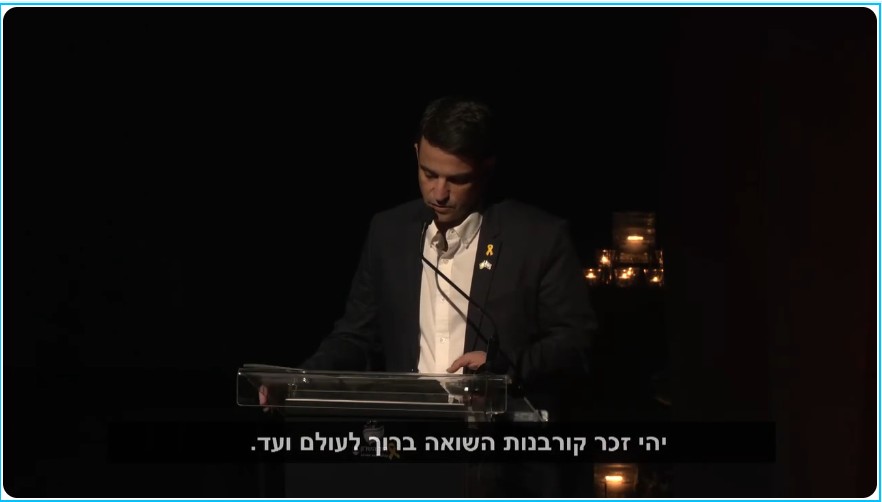
Hod Hasharon mayor Amir Kochavi delivered a Holocaust Remembrance Day speech that ignited national controversy. Critics accused him of drawing a parallel between the IDF and the Nazis, while Kochavi insisted he was speaking about morality and responsibility. After watching the uproar, I went to his Facebook page to read the full speech myself and understand what he actually said.
Hod Hasharon’s mayor, Amir Kochavi, gave a Holocaust Remembrance Day speech that drew praise from MK Ahmed Tibi, a man who has eulogized terrorists from the Knesset podium. That alone should have raised eyebrows. Many Israelis felt Kochavi’s remarks implied a comparison between the IDF and the Nazis. I saw the inflammatory excerpts circulating online, but I wanted to hear the full speech before forming an opinion.
In his Facebook post introducing the speech, Kochavi accused journalist Amit Segal of creating “noise” to distract from the 59 hostages still in Hamas captivity. He claimed his critics were trying to make people forget the hostages. This framing struck me as arrogant. No Israeli has forgotten the hostages. We all want them home. Our debate is over how to achieve that, not whether we care.
The Speech Itself
Kochavi opened with the story of Yosef Wiener, a Holocaust survivor whose grandchildren were murdered in Kfar Aza on October 7. It was a powerful beginning. He could have used it to speak about resilience, unity and the determination to protect Israel. Instead, he pivoted.
He described Israel as a country at war both externally and internally. He referred to the hostages as being in a “personal and family holocaust.” I do not believe the word “holocaust” should be used for anything other than the Holocaust. Too many people already misuse it. We should not be doing that ourselves.
Kochavi then quoted Yehuda Elkana’s distinction between “never again” and “never again for us.” He claimed Jewish morality requires speaking out against atrocities committed against others, even if done “in our name.” That phrasing raised the obvious question. Was he suggesting Israel is committing atrocities in Gaza?
The Wrong Message at the Wrong Time
It is legitimate to debate the conduct of the war. It is legitimate to question strategy, proportionality or goals. But Holocaust Remembrance Day is not the platform for accusing Israel of atrocities. And it is certainly not the time to imply that the IDF is behaving like the Nazis. Even a hint of that comparison is unacceptable.
Kochavi spoke about revenge, blood and destruction not bringing back the dead. But many Israelis do not see this war as revenge. They see it as prevention of future October 7ths. That is a legitimate position. And a Holocaust ceremony is not the place to lecture a captive audience on the morality of the war.
He spoke about building a country that Holocaust survivors would be proud of. We all want that. But he framed the present moment as if Israel has abandoned its moral compass, as if we must “return to” building a strong and ethical society. As if the current struggle is disconnected from our ongoing efforts to protect and strengthen the State.
A Missed Opportunity
Kochavi could have delivered a unifying message. He could have honored Wiener’s family and spoken about the need to protect Israel so that such horrors never happen again. Instead, he used the ceremony to deliver a political rebuke. When criticized, he accused his detractors of distracting from the hostages. That is emotional manipulation. It is wrong.
And it is never acceptable to imply that the IDF resembles the Nazis. Never.
Could Amir Kochavi not have kept the powerful parts of his speech and discarded the pieces that overshadowed them?
You can read the full indepth Substack version of this article here.
👉 Subscribe to my Substack newsletter to follow my new essays and access all fulllength pieces, including extended interviews, analysis, and research: Israel Diaries – The Deep Dive
Discussion (0)
No comments yet. Be the first to share your thoughts!
Leave a Comment